
12 Train Stations in Spain Where the Building Upstages the Destination
Forget Rushing to Your Platform — These Spanish Stations Are the Destination
Here’s a wild thought: what if the best part of your train journey wasn’t the destination, but the building you left from?
Spain has quietly been hoarding some of Europe’s most jaw-dropping railway architecture — and no, we’re not just talking about that tropical jungle inside Madrid Atocha (though, yes, we are getting to that).
From Moorish-inspired palaces that make you feel like you’ve accidentally wandered into the Alhambra, to abandoned mountain stations that look like sets from a Wes Anderson film, Spanish train stations have been serving main character energy since the 1850s.
If you loved our guide to Europe’s most jaw-dropping train stations, you’re about to fall even harder for these Spanish gems.
Pack your camera.
Tell your train to wait.
These 12 stations are worth missing a connection for.
Quick Picks: Find Your Perfect Station
🌿 For the Instagram shot: Madrid Atocha — tropical garden inside a Victorian iron hall
🕌 For Moorish architecture lovers: Toledo — 33 minutes from Madrid, feels like the Alhambra
🏨 For a bucket-list stay: Canfranc — abandoned palace reborn as a five-star hotel
🎨 For Art Nouveau fans: Valencia Nord or Bilbao-La Concordia — ceramic details and Belle Époque charm
🔍 For hidden gems: Zamora or Cartagena — stunning stations most tourists walk right past
🏔️ For cozy vibes: Puebla de Sanabria — storybook mountain cottage with a fireplace
Book your Spanish train tickets →
1. Madrid Atocha — The One With a Literal Rainforest Inside

You’ve probably seen the photos.
A 4,000-square-meter tropical garden with over 7,000 plants.
Red-eared slider turtles gliding through ponds.
Iron arches soaring 27 meters overhead.
It’s giving “Victorian greenhouse meets botanical garden meets fever dream,” and honestly?
It works.
The original station opened in 1892, designed by Alberto de Palacio (who collaborated with Gustave Eiffel’s team — yes, that Eiffel).
After a fire and decades of use, architect Rafael Moneo transformed the historic terminal into this indoor jungle during a 1992 renovation, while high-speed trains were routed to a sleek new annex next door.
If you’re a plant lover, you’ll also want to check out Spain’s most beautiful botanical gardens while you’re in the area.
Insider tip: The memorial for the 2004 Madrid train bombings is inside a glass cylinder near the garden — it’s solemn and beautiful, so take a moment.
Getting there: It’s Madrid’s main station, connected to Metro lines 1 and 10 — you literally can’t miss it.
Search trains departing from Atocha →
2. Toledo — The Moorish Fantasy That Outshines the City

Arriving in Toledo by train feels like stepping into a fairytale.
The 1919 station was designed by Narciso Clavería y de Palacios in neo-Mudéjar style, and it absolutely commits to the bit: horseshoe arches, intricate ceramic tilework, stained glass windows that glow like cathedral light, and a clock tower modeled after Toledo’s own church spires.
The ticket windows alone are museum-worthy — ornate wooden carvings framing delicate stained glass panels.
Inside, the coffered ceilings and arabesque patterns feel more like a Moroccan riad than a transit hub.
The Mudéjar influence here is just a taste of what awaits — for more, explore our guide to Spain’s most breathtaking Moorish architecture.
Pro tip: The high-speed AVE train from Madrid takes just 33 minutes — arrive early, grab a coffee at the station cafe, and actually look up.
Fun fact: The station was declared a Property of Cultural Interest in 1991 — it’s legally protected, as it should be.
Book Madrid → Toledo tickets (from €13) →
3. Valencia Nord — Art Nouveau With Orange Blossom Vibes

Valencia’s main station is a love letter to the region — literally decorated with ceramic oranges, flowers, and agricultural motifs celebrating local harvests.
Opened in 1917 and designed by Demetrio Ribes, it’s peak Valencian Modernisme: colorful mosaics, wooden details, and an exterior that practically screams “Instagram me.”
The building handles 15 million passengers annually, but somehow still feels intimate.
Look for the ceramic panels with messages in Valencian wishing travelers safe journeys — they’ve been there since opening day.
While you’re in Valencia, don’t miss the incredible Mercado Central — one of Europe’s largest and most beautiful food markets.
Don’t miss: The ornamental detailing around the main entrance — it’s been a Historic-Artistic Monument since 1961 for good reason.
Getting there: Dead center of Valencia, walking distance to the Plaza del Ayuntamiento.
Find hotels near Valencia Nord →
4. Canfranc International — The Abandoned Palace Reborn

This is the one.
The legendary “Titanic of the Pyrenees.”
When Canfranc opened in 1928, it was the second-largest station in Europe — a 241-meter-long Beaux-Arts palace with 365 windows and 156 doors, perched at 1,195 meters elevation in the Aragonese Pyrenees.
It was supposed to be Spain’s grand gateway to France, a monument to international rail ambition.
Then in 1970, a train derailed and destroyed a key French bridge.
Service stopped.
The station sat abandoned for over 50 years, slowly becoming a hauntingly beautiful ruin — appearing in films, attracting urban explorers, and fueling countless ghost stories about its rumored role in WWII gold smuggling.
If you love this kind of atmospheric history, you’ll be fascinated by these Spanish villages that were abandoned.
The twist?
As of 2024, it’s been reborn as a five-star hotel (Canfranc Estación, a Royal Hideaway Hotel), with the original platforms and façade meticulously preserved.
Worth the trip? Absolutely — even if you don’t stay, the village and surrounding Pyrenees are spectacular.
5. Barcelona Estació de França — The Grand Dame Nobody Talks About
Everyone heads to Barcelona Sants for high-speed trains.
Meanwhile, Estació de França sits quietly near the Born neighborhood, being absolutely gorgeous and slightly underappreciated.
Built for the 1929 International Exposition, it features a curved iron-and-glass canopy flooding the platforms with natural light, plus a noucentista lobby designed by Duran i Reynals with marble floors, bronze details, and three enormous domes.
People often compare it to Paris’s Musée d’Orsay — same elegant industrial grandeur, same “they don’t build them like this anymore” energy.
Since you’re in Barcelona, check out our guide to 14 must-visit spots in Barcelona and discover Barcelona’s hidden cafes for post-station exploring.
Local tip: On the first Sunday of each month (except August), model train collectors hold a swap meet here — very niche, very charming.
Getting there: No direct Metro connection, but Barceloneta station (L4) is a five-minute walk.
Book Barcelona accommodation →
6. Bilbao-Abando — The Stained Glass You Didn’t Know You Needed

Everyone visits Bilbao for the Guggenheim.
Fewer people realize that the main train station has one of the most stunning stained glass windows in Spain.
Created in 1948 by Jesús Arrecubieta, this 301-piece polychrome masterpiece stretches across the platform area, depicting scenes of Biscayan life: fishermen, rural workers, the Basilica of Begoña.
A 2007 renovation opened up the rear façade with new glazed viewpoints, letting even more light pour through.
The station itself is Neoclassical, efficient, and thoroughly overshadowed by its own window.
Pro tip: Linger on the platform — most people rush through and miss the best views.
7. Bilbao-La Concordia — Art Nouveau on the Riverbank
Just steps from Abando, this smaller station is a modernist jewel.
Opened in 1902 and designed by Severino Achúcarro, La Concordia looks like something from Belle Époque Paris — ceramic tiles, wrought iron, a curved glass-and-metal roof, and a façade that seems to glow in certain light.
It’s a terminal for narrow-gauge trains heading toward Santander and the Cantabrian coast.
The building sits right on the Nervión estuary, and its interior waiting area was designed as a lookout over Bilbao’s old town.
Accidentally Wes Anderson alert: This station is literally featured on their site — bring your symmetry A-game.
8. Almería — The Industrial Romance Spain Forgot
Almería’s old station (built 1890-1893 by French engineer Laurent Farge) is a stunner that time forgot.
Iron-and-glass architecture meets neo-Mudéjar brickwork — think Parisian train hall vibes with Moorish flair.
The Paul Garnier clock in the main hall survived a Civil War bombing; parts of the original stained glass weren’t so lucky.
The station technically isn’t in active use anymore (modern services run from the adjacent intermodal station), but the historic building remains open to the public and absolutely worth seeing.
While you’re in Andalucía, discover the beach in Malaga where they cook food in the sand — it’s unlike anything else.
Historical context: The blend of French industrial style and Andalusian design heritage captures a very specific late-19th-century moment — it’s gorgeous and melancholy.
9. Zamora — Renaissance Drama in the Middle of Nowhere
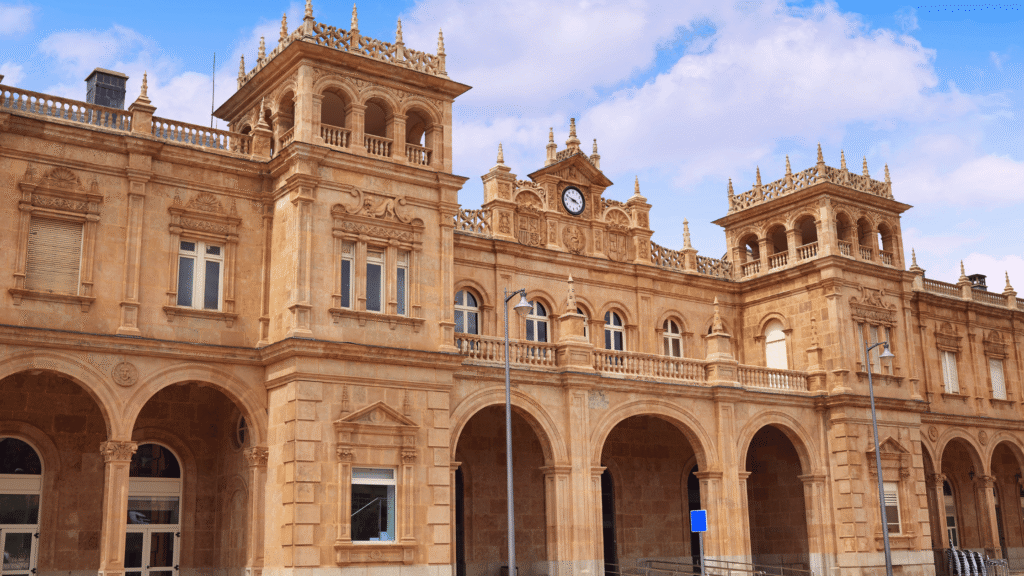
Zamora’s station has one of the wildest backstories in Spanish rail.
Construction started in 1927, stopped during the Civil War, and didn’t finish until 1958.
The result?
An 88-meter-long façade in Neoplateresque style (think Spanish Renaissance revival), built with golden Villamayor stone and featuring late Gothic decorative details.
The city itself is famous for Romanesque architecture, so the station’s Renaissance vibes actually fit right in.
Since 2003, high-speed trains have connected it to Madrid.
Zamora is one of Spain’s most charming small towns — and one of the most overlooked.
Why visit: It’s off the tourist trail, the city is genuinely lovely, and you can feel like you’ve discovered something.
10. Cartagena — Art Nouveau Meets Mythical Creatures
This 1908 station is an underrated treasure in Murcia.
Designed by architect Emilio Antón Hernández, it’s peak Spanish Modernismo — colorful ceramic façade by famed ceramist Daniel Zuloaga, intricate ironwork, and a beautiful wooden coffered ceiling inside.
The tilework features mythical figures and floral motifs that feel almost playful compared to more serious stations.
Cartagena itself is packed with Art Nouveau buildings, so the station sets the tone perfectly.
History buffs should also explore Spain’s most spectacular Roman ruins — Cartagena has impressive ones.
Getting there: It’s still an active station serving trains to Valencia and Madrid.
Search Cartagena train tickets →
11. Aranjuez — Birthplace of Spanish Rail (And Strawberries)
Spain’s second-ever railway line opened here in 1851, connecting Madrid to the Royal Palace of Aranjuez.
Queen Isabella II inaugurated it personally.
The original route passed through strawberry fields — hence the famous “Strawberry Train” heritage service that still runs today.
The current station building dates to the 1920s, designed by Narciso Clavería (same architect as Toledo) in neo-Mudéjar style.
The interior features stunning coffered ceilings and wrought-iron ring lamps.
Must-do: Take the Tren de la Fresa from Madrid’s Railway Museum — hostesses in period costume serve actual Aranjuez strawberries on the return journey, and it’s delightfully old-school.
Book the Strawberry Train experience →
12. Puebla de Sanabria — The Cozy Mountain Cottage
If most stations on this list are grand opera, Puebla de Sanabria is a folk song.
This small station in Zamora province opened in 1958 and looks like a storybook cottage: slate roof, stone ashlars, a beautiful central fireplace inside.
It reflects the traditional architecture of the surrounding Sanabria region — no marble lobbies, just warmth and mountain charm.
The station sits on the Madrid-Galicia line, surrounded by stunning landscape.
It’s the kind of place where you want to stay for the scenery, not just pass through.
For more hidden Spanish gems, check out underrated places in Spain and 14 stunning Spanish towns.
Off-the-beaten-path pick: Combine it with a visit to Lake Sanabria, the largest glacial lake in the Iberian Peninsula.
Find accommodation near Puebla de Sanabria →
Plan Your Spanish Station-Hopping Adventure
Ready to see these beauties in person?
Here’s everything you need to plan your trip.
Best Ways to Book Spanish Trains
Renfe — Spain’s national rail operator, best for AVE high-speed trains and the most direct booking experience.
Trainline — Compare prices across operators and book in English with easy mobile tickets.
Omio — Great for comparing trains, buses, and flights for the best overall route.
Consider a Spain Rail Pass
If you’re planning to visit multiple stations, a Eurail Spain Pass might save you money — especially for longer distances.
Don’t Forget Travel Insurance
Delays happen, luggage gets lost, and plans change.
SafetyWing offers affordable travel medical insurance that covers you across Europe.
Keep Exploring Spain
Loved these stations?
Here are more Spanish adventures waiting for you:
- Spain’s Most Breathtaking Moorish Architecture — For more of that Mudéjar magic
- Insanely Beautiful Spanish Castles — If grand historic buildings are your thing
- Castle Hotel Stays in Spain — Sleep like royalty
- Spain’s Most Spectacular Roman Ruins — More ancient history
- 10 Epic Places in Spain — The ultimate bucket list
- The Camino de Santiago: A Beginner’s Guide — Some of these stations are along the route
- 14 Medieval Villages in Spain — Pair with your station visits
Final Boarding Call
Spain has been quietly flexing its railway architecture for over 170 years — and honestly, most travelers walk right past it chasing connections.
Next time you’re booking that AVE to Barcelona or plotting a day trip from Madrid, build in an extra 20 minutes.
Look up at the iron arches.
Notice the tile work.
Let yourself be impressed by a building whose entire job was just getting you somewhere else.
Because sometimes, the best travel moments happen before you even leave the station.
Have a favorite Spanish train station we missed?
Drop it in the comments below.
And if you’ve actually stayed at the Canfranc hotel, we need details.
Related Posts You’ll Love:


