Spain’s Best Food Markets That Will Make You Forget About Restaurants
Here’s a travel secret that Spanish locals have known forever: the best meals in the country don’t come from restaurants.
They come from mercados — those glorious covered markets where vendors have been selling the freshest produce, seafood still glistening from the morning catch, and jamón that’s been aging longer than some people have been alive.
These aren’t your sad, tourist-trap food halls with overpriced smoothie bowls and artisanal this-and-that.
We’re talking about real markets where grandmothers elbow past you to get the best cuts of meat, where fishmongers will fillet your purchase while gossiping about the neighborhood, and where you can assemble a picnic feast for the price of a mediocre hotel breakfast.
Many of Spain’s finest markets have recently added tapas bars and counters where you can eat what you’ve just watched being prepared, turning grocery shopping into an all-day culinary adventure.
Whether you’re a serious home cook hunting for ingredients or just someone who believes eating should be an experience, these food markets will absolutely wreck your travel budget — in the best possible way.
Quick Picks: Find Your Perfect Market
🦐 For jaw-dropping seafood: Mercado de Abastos, Santiago — Galicia’s freshest, cooked on the spot
🏛️ For architectural beauty: Mercado Central de Valencia — Art Nouveau masterpiece filled with vegetables
🍷 For tapas and wine grazing: Mercado de San Miguel, Madrid — gourmet bites until midnight
🐙 For authentic local vibes: Mercado de Triana, Seville — where “real” Seville shops
🧀 For regional specialties: El Fontán, Oviedo — Asturian cheese, cider, and fabada beans
📸 For the famous experience: La Boqueria, Barcelona — legendary for a reason (if you go early)
1. La Boqueria, Barcelona – The One That Started It All

Let’s get the obvious one out of the way first, because La Boqueria genuinely deserves its legendary status despite the tourist crowds.
Officially known as Mercat de Sant Josep de la Boqueria, this market has been feeding Barcelona since 1217, when meat sellers first set up tables near the old city gate.
The current modernista structure dates to 1914, with its stunning iron and glass entrance leading into 13,000 square meters of sensory overload.
More than 200 stalls sell everything from mountains of gleaming fruit to whole legs of jamón ibérico to seafood displays so gorgeous they belong in art galleries.
The secret to surviving Boqueria?
Arrive before 10 AM, skip the fruit cup stands near the entrance (tourist traps), and head toward the back where locals actually shop.
El Quim de la Boqueria, a legendary 16-meter counter, serves fried eggs with baby squid that have achieved cult status among Barcelona’s food obsessives.
Watch the fishmongers at work, sample 25 different kinds of olives at Graus Olives e Conserves, and leave with enough provisions to make any rental apartment kitchen feel like a Michelin-starred restaurant.
While you’re in Barcelona, check out our guide to 14 must-visit spots in Barcelona and discover Barcelona’s hidden cafes.
Pro tip: Weekday mornings are infinitely better than weekends — Saturday is a zoo.
Hours: Monday-Saturday 8am-8:30pm, closed Sundays
2. Mercado Central de Valencia – Architecture Meets Gastronomy
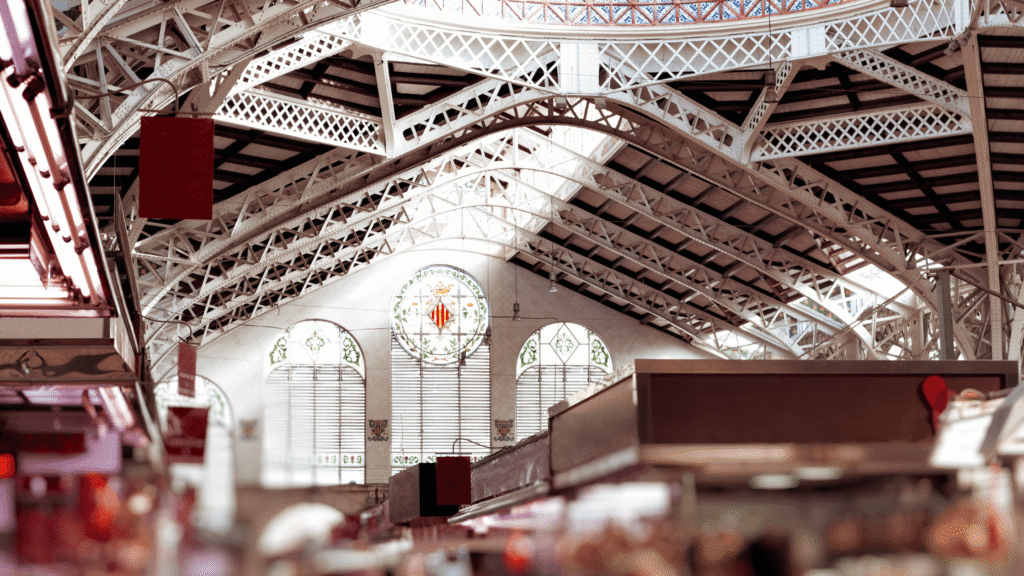
Valencia’s Central Market isn’t just one of Europe’s oldest and largest running food markets — it’s also one of the most beautiful buildings you’ll ever see filled with vegetables.
Completed in 1928 after 14 years of construction, this Valencian Art Nouveau masterpiece features soaring iron and glass domes, colorful ceramic tiles, and stained glass windows that filter Mediterranean light onto the produce below.
Over 1,000 stalls (yes, really) fill the 8,000-square-meter space, selling everything from just-picked oranges to live eels to vegetables from the famous Valencian huerta gardens.
The market is still remarkably authentic — this is where local chefs shop for paella ingredients and where abuelas come every morning to gossip over the day’s catch.
Arrive between 7:30 and 10 AM to see it at its most vibrant, before the stalls start winding down around 2 PM.
Don’t leave without trying horchata (the sweet tiger nut drink Valencia is famous for), sampling some bacalao from the specialty stalls, and standing under the central dome just to appreciate the sheer ambition of building something this gorgeous for the sole purpose of selling food.
Valencia also has one of Spain’s most jaw-dropping train stations — architecture lovers, take note.
Pro tip: The market closes in the afternoon — this is a morning destination only.
Hours: Monday-Saturday 7:30am-3pm, closed Sundays
3. Mercado de la Ribera, Bilbao – Europe’s Largest Covered Market

The Guinness Book of World Records officially recognized Bilbao’s Mercado de la Ribera as Europe’s largest covered food market in 1990, and honestly, the title still fits.
Spanning 10,000 square meters on the right bank of the Nervión River, this Art Deco beauty was built in 1929 by architect Pedro Ispizua — the same architect who trained alongside Gaudí.
The building itself looks like a stranded ship, and the comparison feels appropriate given how much fresh seafood moves through here daily.
Three floors are dedicated to different products: ground floor for the freshest Basque seafood, first floor for meats and deli products, second floor for fruits and vegetables.
But the real magic happened in 2015, when the market added a food court that transformed visits from pure shopping to full-day eating experiences.
La Bodeguilla serves over 30 variations of gildas (those classic Basque pintxos with guindilla pepper, anchovy, and olive), while the ground-floor café-bar has a terrace overlooking the river and hosts live jazz.
You can even buy fresh fish and have the market bar cook it for you — the ultimate boat-to-plate experience.
Bilbao also has stunning stained glass at its train station — see our guide to 12 jaw-dropping train stations in Spain.
Pro tip: Saturday morning is the most lively, but also the most crowded — Friday is the sweet spot.
Hours: Monday-Saturday 8am-2:30pm (food court stays open later)
4. Mercado de San Miguel, Madrid – The Gourmet Temple

Mercado de San Miguel isn’t your grandmother’s market — it’s more like a gourmet food hall that happens to be housed in a gorgeous 1916 iron and glass structure steps from Plaza Mayor.
Reopened in 2009 after extensive renovation, this market has traded traditional grocery stalls for more than 30 vendors selling prepared foods, wines, oysters, and Spanish delicacies ready for immediate consumption.
Yes, it’s touristy — the open-until-midnight hours and prime location guarantee that.
But the quality is genuinely excellent, and there’s something magical about wandering with a glass of Albariño in one hand and a cone of jamón ibérico in the other.
The wine and cava bar pours some of Spain’s finest by the glass, the oyster stand shucks them fresh as you watch, and the olive oil vendors offer tastings that will ruin you for supermarket oils forever.
Best strategy: visit late evening when the after-work crowd arrives and the market becomes a sophisticated tapas crawl under one roof.
Pro tip: Prices are higher than other markets — this is about the experience, not budget shopping.
Hours: Sunday-Thursday 10am-midnight, Friday-Saturday 10am-1am
5. Mercado de Abastos, Santiago de Compostela – The Pilgrim’s Reward
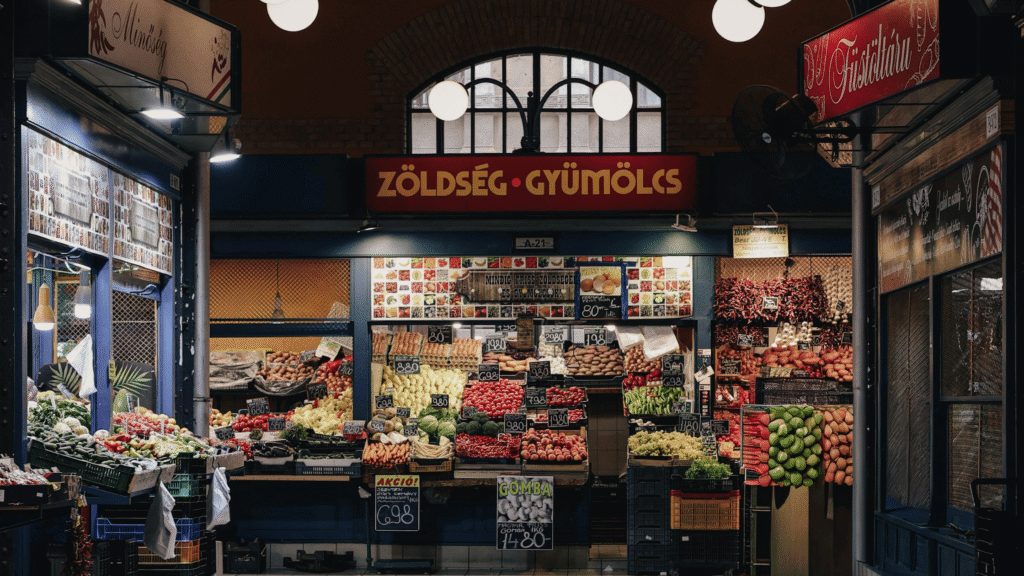
If you’ve just walked 800 kilometers across Spain on the Camino de Santiago, you deserve a market visit — and the Mercado de Abastos is the second most visited spot in the city after the Cathedral itself.
Dating to the late 19th century, this stone-built market in the heart of Galicia is an absolute seafood paradise, featuring products from one of the world’s richest fishing grounds.
Over 300 stalls spread across eight halls sell percebes (goose barnacles) that cost more per kilo than steak, pulpo (octopus) that rivals any restaurant version, and seafood so fresh it’s practically still swimming.
Here’s the genius part: many stalls will prepare your purchases on the spot, or you can take them to restaurant Mariscomanía inside the market where they’ll cook whatever you’ve bought for just a few euros.
Thursday is market day, when farmers from surrounding villages bring their products, and the already-bustling space reaches peak Galician intensity.
The Tetilla cheese, shaped like breasts (tetilla literally means “little breast”), is as delicious as its name is giggle-worthy.
If you walked the Camino to get here, you’ll appreciate our beginner’s guide to the Camino de Santiago.
Pro tip: Buy your seafood, take it to Mariscomanía, and pay a small cooking fee — it’s the best-value seafood meal in Galicia.
Hours: Monday-Saturday 8am-3pm, closed Sundays
Find hotels in Santiago de Compostela →
6. Mercado Central de Atarazanas, Málaga – Moorish History, Modern Bounty

The Atarazanas Market occupies a building with some seriously impressive heritage — the ornate Moorish gateway you walk through dates from the 14th century, when this was a shipyard for the Nasrid kingdom.
The rest of the iron-and-glass structure arrived in the 19th century, and today the combination of Islamic architecture and Victorian market hall creates one of Spain’s most distinctive food shopping experiences.
Fresh fish dominates here, as you’d expect in a Mediterranean port city, with vendors offering everything from sardines to whole tuna to those mysterious creatures that only locals seem to know how to prepare.
The spectacular stained-glass window at one end depicts Málaga’s major monuments and floods the interior with colored light on sunny mornings.
Surrounding the market, tapas bars serve cold beer and fresh-fried fish at prices that remind you Málaga hasn’t completely surrendered to Costa del Sol tourism.
Visit on a Saturday morning when the whole neighborhood seems to converge, and you’ll understand why markets remain central to Spanish social life.
Speaking of Málaga beaches, don’t miss our guide to the beach where they cook food in the sand — another unforgettable food experience.
Pro tip: The tapas bars just outside the market often have better prices than inside — scope them out.
Hours: Monday-Saturday 8am-3pm, closed Sundays
7. Mercado de Triana, Seville – Across the Bridge to Authenticity
Cross the Guadalquivir into Triana, the neighborhood that considers itself the “real” Seville, and you’ll find a market that feels decades removed from tourist-focused Seville across the river.
The Mercado de Triana has been serving this working-class-turned-bohemian neighborhood since 1823, and while the building has been modernized, the community feel remains remarkably intact.
Jamón ibérico and chorizo from pigs raised on acorns in the Sierra de Aracena, sherry wines from Jerez served by the glass, fresh produce that actually tastes like something — Triana delivers the Andalusian goods.
The tapas counters surrounding the market serve some of Seville’s most authentic home cooking at prices that haven’t caught up with the neighborhood’s gentrification.
Below the market, you can visit the fascinating Castillo de San Jorge archaeological site, a former Inquisition prison — because in Seville, even grocery shopping comes with historical layers.
Seville is Spain’s most colorful city — the market is just one reason to fall in love with it.
Pro tip: Come hungry and graze the tapas bars around the market’s perimeter — it’s Seville’s best-value lunch.
Hours: Monday-Saturday 9am-3pm, closed Sundays
8. El Fontán, Oviedo – Asturias’ Best-Kept Secret
Hidden in Oviedo’s old town, El Fontán is the kind of market that rewards travelers who venture beyond obvious destinations.
This covered market in the capital of Asturias specializes in the region’s distinctive products: fabada beans, the famously pungent Cabrales cheese, cider that’s poured from great heights, and embutidos (cured meats) you won’t find anywhere else in Spain.
The building itself is a work of 19th-century elegance, with iron columns and a glass roof that makes even cabbage shopping feel slightly aristocratic.
Thursday and Saturday are the busiest days, when local farmers supplement the permanent stalls with their own produce.
After shopping, retreat to one of the surrounding sidrerías (cider houses) to eat what you’ve bought alongside sidra poured in that theatrical Asturian style.
Oviedo is a gateway to Spain’s most charming small towns in Asturias — Cudillero and Lastres are must-visits.
Pro tip: Don’t leave Asturias without trying Cabrales cheese — it’s intense, but unforgettable.
Hours: Monday-Saturday 8am-3pm, closed Sundays
9. Mercado de Maravillas, Madrid – Where Locals Actually Shop
Here’s a market that tourists almost never find, which is exactly why you should go.
Mercado de Maravillas, located in the northern Tetuán neighborhood, is the largest municipal market in Europe with nearly 9,000 square meters and over 250 stalls across two floors.
This is where actual Madrid families do their actual grocery shopping, which means prices are real, quality is excellent, and you might be the only obvious tourist in sight.
The neighborhood’s immigrant communities have added international flavors — Latin American products, Asian ingredients, halal butchers — creating a multicultural food experience that reflects contemporary Madrid far better than the historic center markets.
Getting here requires a metro ride to Tetuán, but the reward is experiencing a Spanish market as social institution rather than tourist attraction.
For more off-the-tourist-track Spain, check out our guide to underrated places in Spain.
Pro tip: Come Saturday morning for peak energy — the whole neighborhood shows up.
Hours: Monday-Friday 9am-2pm and 5:30pm-8:30pm, Saturday 9am-3pm
Getting there: Metro to Tetuán (Line 1)
10. Mercado de la Paz, Madrid – Salamanca’s Sophisticated Secret
If you want to shop where Madrid’s old-money families send their cooks, head to Mercado de la Paz in the posh Salamanca district.
Opened in 1882, this is one of Madrid’s oldest markets, and the clientele tends toward well-dressed señoras who know exactly which cuts of meat they want and expect the butcher to remember their names.
Quality here is exceptional — this is where to find the best jamón ibérico de bellota, perfectly aged cheeses, and gourmet products that justify their premium prices.
The market has resisted the food-hall renovation trend, maintaining its identity as a serious grocery market rather than a dining destination.
That said, the counters at places like Jurucha serve pintxos that rival any Salamanca tapas bar at a fraction of the price.
It’s the perfect market for travelers who appreciate quality over quantity and don’t mind paying slightly more for the privilege of shopping alongside Madrid’s most discerning home cooks.
Pro tip: Combine with a stroll through the elegant Salamanca neighborhood — it’s Madrid’s version of the Upper East Side.
Hours: Monday-Friday 9am-2:30pm and 5:30pm-8pm, Saturday 9am-2:30pm
Getting there: Metro to Serrano or Velázquez (Line 4)
Plan Your Spanish Market Tour
Ready to eat your way through Spain?
Here’s how to do it right.
Getting Around
Most markets are in city centers and accessible by public transit.
Market Timing Tips
- Arrive early: 8-10 AM is prime time for selection and authenticity
- Check closing times: Most close by 2-3 PM
- Avoid Sundays: Nearly all Spanish markets are closed
- Saturday = busy: Great energy, but crowded
Travel Insurance
Food adventures should be covered — especially if you’re trying percebes for the first time.
Keep Exploring Spanish Food Culture
Hungry for more?
Here’s where to eat next:
- The Beach in Málaga Where They Cook Food in the Sand — An unforgettable culinary experience
- Spain’s Most Charming Small Towns — Where grandmother’s recipes still rule
- The Camino de Santiago: A Beginner’s Guide — Walk up an appetite
- Spain’s Most Colorful City — Seville’s food scene is unmatched
- 14 Must-Visit Spots in Barcelona — Beyond La Boqueria
The Bottom Line
Spain’s food markets aren’t just places to buy groceries — they’re theaters of daily life, windows into regional culture, and some of the best eating experiences the country has to offer.
Skip the overpriced restaurant with the English menu.
Head to the market instead.
Watch the fishmonger fillet your lunch.
Argue with a grandmother over the last good tomatoes.
Eat standing up at a counter while the vendor pours you wine.
This is how Spain actually eats.
And now you know where to join them.
Which Spanish market blew your mind?
Or have you discovered a hidden gem we missed?
Tell us in the comments — we’re always hunting for the next great mercado.
Related Posts You’ll Love:
- The Beach in Málaga Where They Cook Food in the Sand
- Spain’s Most Charming Small Towns
- Spain’s Most Colorful City
Bookmark this post — your stomach will thank you.