The Spanish City That Makes Every Other City Look Grayscale
If Spain had a heartbeat, it would sound like Seville — rhythmic, passionate, and full of color.
This is a city that doesn’t just exist; it performs.
Every street feels like a painting, every plaza like a stage, and every local like they were born knowing how to dance.
Welcome to Seville — the most colorful city in Spain, and maybe the most soul-stirring one too.
Quick Guide: Why Seville Captivates
🎨 The colors: Golden plazas, cobalt blue doorways, fuchsia bougainvillea, and azulejo tiles everywhere
🏛️ The architecture: Moorish palaces, Gothic cathedrals, and Renaissance grandeur — all in one city
💃 The culture: Flamenco isn’t performed here — it lives here
🍊 The atmosphere: Orange trees perfume every street, tapas flow freely, and life moves slowly (beautifully)
🎉 The festivals: Feria de Abril and Semana Santa are two of Europe’s most spectacular celebrations
A City That Lives in Color
Seville doesn’t do neutral.
From the golden glow of the Plaza de España to the orange-scented courtyards of the old town, everything here radiates warmth.
The whitewashed walls reflect the Andalusian sun, while tiles — azulejos — splash blues, greens, and yellows across the city like confetti.
Even the shadows have personality.
Walk through Barrio Santa Cruz, and you’ll see bursts of color everywhere — cobalt blue doorways, fuchsia bougainvillea climbing over terracotta balconies, and intricate tilework that turns every corner into art.
This isn’t a city that was painted colorful.
It was born this way.
Where the Color Comes From
Seville’s vibrance isn’t just aesthetic — it’s cultural.
This is where Moorish architecture, Catholic heritage, and Andalusian flair collide in the most spectacular way.
For nearly 800 years, this region was part of Al-Andalus — the Islamic civilization that ruled much of Spain.
The Moors brought geometric tilework, intricate arches, cooling courtyards, and a love of pattern and color that still defines Seville today.
Then came the Christian reconquest, the Spanish Empire’s golden age, and centuries of religious and artistic expression that layered onto what the Moors left behind.
The result?
A city where a 14th-century Moorish palace sits next to the world’s largest Gothic cathedral, and both are covered in colors that seem to glow from within.
For more on this architectural fusion, see our guide to Spain’s most breathtaking Moorish architecture.
The Must-See Landmarks
The Alcázar
The Royal Alcázar is a Moorish palace so stunning that Game of Thrones used it as the Water Gardens of Dorne.
The courtyards shimmer with mosaics and fountains.
The gardens are lush, fragrant, and impossibly romantic.
And the tilework — centuries of intricate azulejos covering every surface — is a masterclass in color and geometry.
This is Spain’s oldest royal palace still in use, and every corner feels like stepping into a fairy tale.
Pro tip: Book tickets online in advance — the lines can be brutal, especially in spring and fall.
Book Alcázar skip-the-line tickets →
Seville Cathedral & La Giralda
The Cathedral of Seville is the largest Gothic cathedral in the world.
Inside, golden altarpieces rise to the ceiling, stained glass filters colored light across ancient stone, and Christopher Columbus rests in an ornate tomb.
But the real magic is climbing La Giralda — the bell tower that was once a Moorish minaret.
The ramps (35 of them, designed for horses) wind upward to panoramic views over Seville’s rooftops, with the Alcázar gardens spreading out below.
At sunset, the city turns gold.
Book Cathedral & Giralda tickets →
Plaza de España
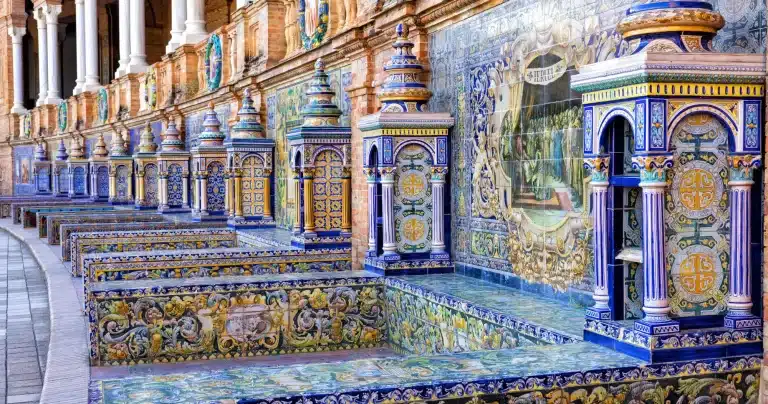
Built for the 1929 Ibero-American Exposition, Plaza de España is Seville’s most photogenic landmark — and that’s saying something.
The semi-circular plaza curves around a canal where you can rent rowboats.
Each of Spain’s provinces is represented by a colorful tile alcove along the walls.
The bridges, the towers, the reflections in the water — it’s almost aggressively beautiful.
Star Wars filmed here (it’s Naboo in Episode II), and you’ll understand why the moment you see it.
Best time to visit: Early morning or late afternoon for golden light and fewer crowds.
Festivals That Paint the City
If you think Seville is colorful on a regular day, wait until festival season.
Feria de Abril
For one week every spring (usually late April), the city transforms into a whirl of color and celebration.
Women wear bright flamenco dresses (trajes de flamenca) in every color imaginable.
Horse-drawn carriages decorated with flowers parade through the streets.
Lanterns light up the night as families eat, drink, and dance sevillanas until dawn.
It’s one of Spain’s largest festivals — and one of its most photogenic.
Semana Santa (Holy Week)
A more solemn but equally spectacular expression of devotion.
Religious brotherhoods carry massive floats (pasos) through the streets, depicting scenes from the Passion of Christ.
Candlelight flickers.
Incense fills the air.
Penitents in pointed hoods walk in silence.
Whether you’re religious or not, the atmosphere is unforgettable.
Everyday Magic
Color in Seville isn’t just about architecture or festivals.
It’s in the rhythm of daily life.
In the way locals fill the air with laughter over tapas and tinto de verano.
In the soft strum of a guitar drifting from an open window.
In the orange trees lining every street, perfuming the air year-round.
Sit on a terrace with a view of the cathedral, and you’ll see it — life here moves slowly, beautifully, vividly.
Seville is a city that still takes two-hour lunches seriously.
That still believes in the afternoon siesta.
That understands that color isn’t decoration — it’s a way of being.
Where to Find the Best Colors
Barrio Santa Cruz
The old Jewish quarter is a labyrinth of narrow streets, hidden plazas, and colorful doorways.
Get lost on purpose.
Every turn reveals another Instagram moment.
Triana
Cross the Guadalquivir River to Seville’s most authentic neighborhood.
The Mercado de Triana is one of Spain’s best food markets — and the surrounding streets are full of ceramic workshops and flamenco bars.
Alameda de Hércules
Seville’s hippest neighborhood, full of street art, vintage shops, and colorful cafe terraces.
Come for the Sunday flea market.
Metropol Parasol (Las Setas)
The “Mushrooms of Seville” — a massive wooden structure that’s one of the world’s largest.
Climb to the rooftop walkway at sunset for 360-degree views over the city.
Why You’ll Fall in Love With It
Seville has a way of getting under your skin.
It’s warm but not overwhelming, traditional but full of life, and endlessly photogenic.
You’ll come for the architecture, but stay for the feeling — that sense that everything and everyone is drenched in light and color.
And maybe that’s Seville’s secret: it doesn’t just show you its beauty — it makes you feel like you’re part of it.
This is a city where strangers become friends over tapas.
Where you’ll hear flamenco when you least expect it.
Where even a walk to the grocery store feels like a scene from a film.
Because in Seville, color isn’t decoration.
It’s the way life is lived.
Plan Your Seville Trip
Ready to experience Spain’s most colorful city?
Getting There
Seville has an international airport with connections across Europe.
High-speed AVE trains connect Seville to Madrid (2.5 hours) and Barcelona (5.5 hours).
Where to Stay
Stay in the historic center (Barrio Santa Cruz or near the Cathedral) for maximum color immersion.
What to Book
- Alcázar skip-the-line tickets →
- Cathedral & Giralda tickets →
- Flamenco show in Triana →
- Seville food tour →
Travel Insurance
Tapas crawls, rooftop sunsets, and spontaneous flamenco nights — make sure you’re covered.
Keep Exploring Andalucía
Fell for Seville?
Here’s more of southern Spain to love:
- Spain’s Most Breathtaking Moorish Architecture — The Alcázar is just the beginning
- Spain’s Most Charming Small Towns — Day trips from Seville
- Spain’s Best Food Markets — Triana and beyond
- Spain’s Most Spectacular Roman Ruins — Nearby Itálica
- 8 Spanish Churches That Prove Medieval Architects Were Wizards — The cathedral and more
The Bottom Line
There are colorful cities all over the world.
But Seville is different.
The color here isn’t paint — it’s history.
It’s the Moors who laid the tiles.
The Catholics who gilded the altars.
The Andalusians who planted the orange trees and refused to rush.
Seville isn’t trying to be beautiful.
It just is.
And once you’ve walked its streets, felt its warmth, and watched the sunset turn the Alcázar gold, you’ll understand why travelers have been falling in love with this city for centuries.
Go.
Get lost in the colors.
Let Seville work its magic.
Have you been to Seville?
What captured your heart most — the architecture, the food, the festivals, or something else entirely?
Tell us in the comments.
Related Posts You’ll Love:
- Spain’s Most Breathtaking Moorish Architecture
- Spain’s Best Food Markets
- Spain’s Most Charming Small Towns
Bookmark this post — Seville is waiting.