Spain’s Most Magnificent Castles That Look Straight Out of Fantasy
There’s a reason Spain’s very name in Spanish—España—sounds like “land of castles” (it actually derives from the Roman “Hispania,” but the poetic coincidence is perfect).
This country has more castles than almost anywhere on Earth, a legacy of centuries when Christian and Muslim kingdoms fought back and forth across the peninsula.
Every hilltop, river crossing, and strategic pass seems to have a fortress, from crumbling towers to palace-castles that could host medieval royalty tomorrow.
Some are so perfect they inspired Disney animators; others are so dramatically positioned they defy belief.
Whether you’re a history buff, an architecture lover, or just someone who appreciates a really good castle, Spain delivers like nowhere else.
Ready to explore fortresses that make Game of Thrones sets look modest?
1. Alcázar of Segovia
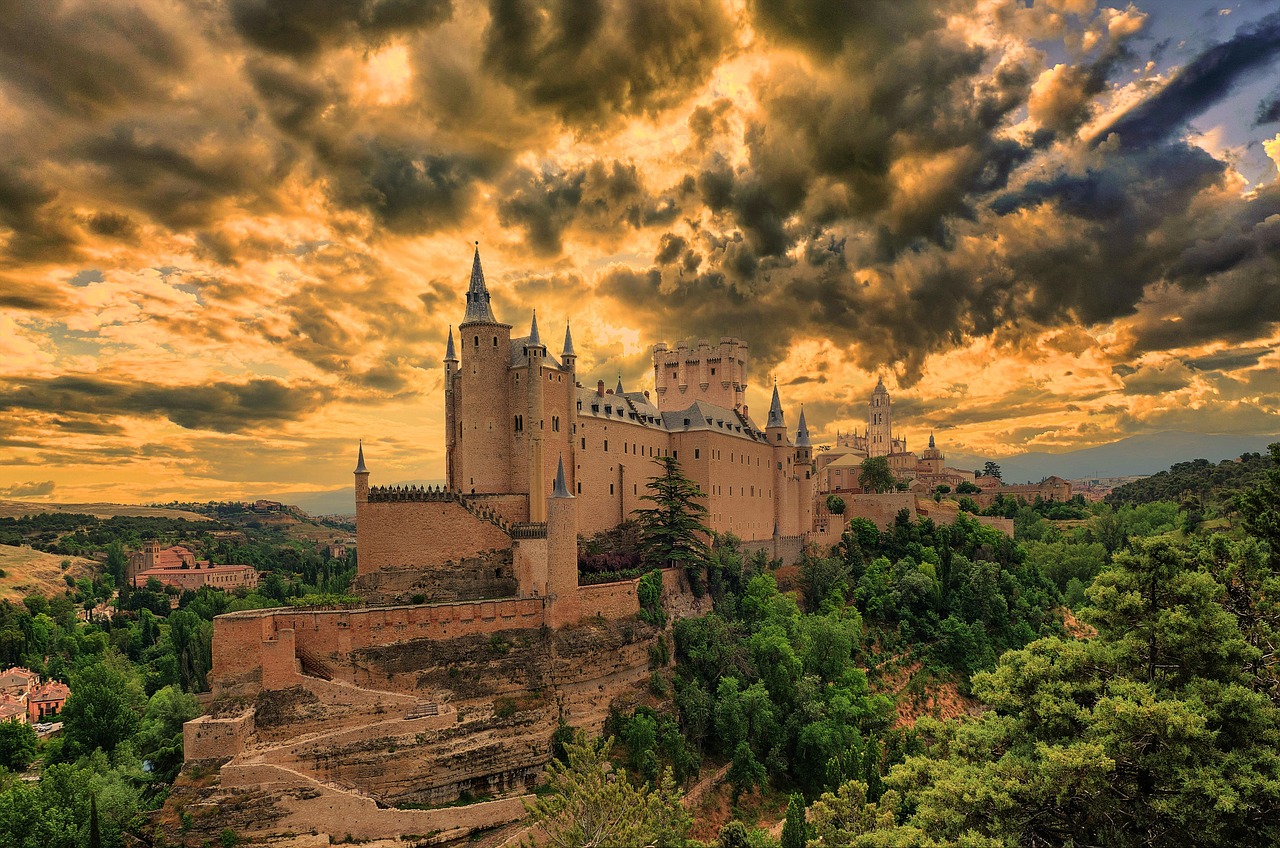
Rising from a rocky promontory shaped like the bow of a ship, this is the fairy-tale castle—literally, since it reportedly inspired Disney’s Cinderella Castle.
The Alcázar’s distinctive silhouette, with its slate-roofed towers and dramatic position at the confluence of two rivers, is one of the most recognizable in Spain.
The site has been fortified since Roman times, but the current structure dates primarily from the 12th through 16th centuries, with major additions by various Castilian kings.
Queen Isabella I was crowned here in 1474, beginning the reign that would unite Spain and launch Columbus toward the Americas.
Inside, nine decorated rooms showcase a mix of Christian and Mudéjar styles, with the Sala de las Piñas featuring an astonishing ceiling of carved golden pinecone-shaped ornaments.
The Sala de los Reyes displays sculptures of all 52 kings who ruled from this castle, creating a sculptural history of Castile.
Climb the Tower of Juan II for panoramic views of Segovia, the surrounding plains, and the Sierra de Guadarrama mountains rising to the north.
2. Alhambra, Granada
Yes, the Alhambra is a palace, but it’s also a fortress—and arguably the most magnificent defensive complex ever built in medieval Europe.
The Alcazaba, the oldest section, is pure military architecture: massive walls, watchtowers, and defensive positions designed to hold Granada against any attacker.
The contrast between the brutal Alcazaba and the delicate Nasrid Palaces creates the Alhambra’s unique character—a place of both strength and unimaginable beauty.
From the Torre de la Vela, the main watchtower, views sweep across Granada to the Sierra Nevada, explaining exactly why this position was worth defending for centuries.
The fortified walls enclosing the plateau contain thirteen defensive towers, some of which house elaborate “vertical palaces” in miniature.
This was the last stronghold of Muslim Spain, falling to Ferdinand and Isabella only in 1492—the same year Columbus sailed.
Every year, the Alhambra is the most visited monument in Spain, proof that even after 500 years, this castle’s magic hasn’t faded.
3. Castle of Loarre, Aragón
Perched 1,000 meters high on a limestone outcrop overlooking the Aragonese plains, Loarre is often called the best-preserved Romanesque castle in the world.
Built in the 11th century by King Sancho Ramírez I to defend against Muslim forces, the castle’s cylindrical towers and weathered stone walls look exactly as a medieval fortress should.
The castle incorporates the Romanesque Church of Santa María directly into its defensive structure, with beautifully carved capitals and a semi-circular apse.
The limestone bedrock on which it stands made undermining impossible, adding natural protection to already formidable walls.
Ridley Scott used Loarre as a filming location for Kingdom of Heaven, though the castle needs no Hollywood endorsement to impress.
The views from the walls stretch across the Pyrenean foothills, with the high peaks visible on clear days.
This castle earned the top spot in Spanish travel polls as the most breathtaking fortress in the country—even beating the Alcázar of Segovia.
4. Coca Castle, Segovia Province
If most castles are built for intimidation, Coca Castle was built to impress—and it succeeds spectacularly.
This 15th-century Gothic-Mudéjar masterpiece rises from flat ground protected by a 40-foot dry moat, its tan brick towers decorated with geometric patterns.
Unlike defensive fortresses positioned on hills, Coca was designed as a showy residence, with decorative elements that prioritize beauty over brute strength.
The distinctive brickwork shows Islamic influence—the pointed Moorish merlons crowning each tower look more ornamental than functional.
The castle was the seat of the powerful Fonseca family, who clearly wanted everyone to know exactly how rich and powerful they were.
Inside, coffered ceilings and elaborate decoration transport visitors to 15th-century aristocratic Spain.
Located between Segovia and Valladolid, Coca Castle combines easily with the Alcázar for a day of contrasting castle experiences.
5. Peñafiel Castle, Valladolid Province
This castle looks like a stone ship anchored on the Castilian plateau—because that’s essentially what it is.
Built on a long, narrow ridge, Peñafiel stretches 210 meters in length while only reaching 33 meters at its widest point, maximizing the natural defenses of the terrain.
When illuminated at night, the castle genuinely resembles a massive vessel sailing through a sea of vineyards.
The current structure dates from the 15th century, though fortifications have occupied this strategic position since the 10th century.
Today, the castle houses the Provincial Wine Museum, making perfect sense given its position overlooking the Ribera del Duero wine region.
Guided tours take visitors through the castle’s medieval spaces before depositing them in galleries explaining the region’s wine heritage.
The combination of dramatic architecture, sweeping views, and excellent wine makes Peñafiel a complete destination.
6. Belmonte Castle, Cuenca Province
This 15th-century fortress has a unique triangular design unlike almost any other castle in Spain.
Built by Juan Pacheco, Marquis of Villena and one of the most powerful men in 15th-century Castile, the castle was designed for both defense and luxury.
The three-sided layout with massive round towers at each angle created overlapping fields of fire while enclosing comfortable living quarters.
Mudéjar-style carved ceilings inside contrast with the military exterior, showing that even medieval warriors wanted beauty in their homes.
The castle remained in the Pacheco family for centuries and was later used as a filming location for El Cid with Charlton Heston.
A World Combat Medieval Championship is held here annually, bringing armored fighters from around the world to compete in the castle’s shadow.
Belmonte sits in a region of Spain that few foreign tourists visit, making it feel like a genuine discovery.
7. Royal Palace of Olite, Navarra
This castle proves that not all medieval fortresses were grim—the Royal Palace of Olite was designed primarily for pleasure and courtly life.
Built by King Charles III of Navarre in the 15th century, the palace was once one of the most luxurious residences in Europe.
Contemporary chronicles describe hanging gardens, exotic animals, and ice brought from the mountains to cool summer drinks.
The distinctive towers, each with a different design, create a skyline that looks almost fantastical against the Navarran countryside.
Though much of the interior decoration is gone, the architecture itself speaks of a court that valued aesthetics as much as defense.
A national Parador hotel occupies part of the complex, allowing guests to sleep where medieval kings once held court.
Combined with nearby wine country and the Camino de Santiago pilgrimage route, Olite makes an excellent base for exploring Navarra.
8. Castillo de la Mota, Valladolid Province
This massive brick fortress in Medina del Campo is one of the largest and best-preserved late medieval castles in Spain.
The original structure dates to the 11th and 12th centuries, but the current impressive form emerged during 15th-century rebuilding.
Queen Isabella I used this castle as a royal residence and treasury, and it later served as a prison for high-status captives.
The castle sits on an artificial hill—medieval builders literally created the elevation to give their fortress commanding views.
The extensive outer walls with their distinctive crenelations create a textbook image of what a Spanish castle should look like.
Today, the castle hosts educational programs and can be visited to explore its military architecture and royal history.
Medina del Campo was once one of the most important market towns in Europe, and the castle reflects that former prosperity.
9. Alcázar of Toledo
Crowning the highest point of Toledo’s dramatic hilltop setting, this fortress dominates the city that was once Spain’s capital.
The site has been fortified since Roman times, and virtually every power that controlled Toledo—Visigoths, Moors, Castilians—added to or modified the structure.
The current fortress, rebuilt after devastating damage in the Spanish Civil War, houses the Army Museum with an impressive collection of military artifacts.
Four distinctive towers mark the corners, creating the angular silhouette visible from everywhere in Toledo and beyond.
The library on the upper floor contains over 70,000 volumes, though the building’s martial history dominates visitor experience.
Views from the terrace sweep across the Tagus River valley, the same views that made this position valuable for over 2,000 years.
The Alcázar anchors any visit to Toledo, a city so rich in history that UNESCO designated the entire historic center as a World Heritage Site.
10. Bellver Castle, Mallorca
This 14th-century castle is unique in Spain—and nearly unique in Europe—for its circular design.
Built by King James II of Mallorca, Bellver is one of only a handful of round castles ever constructed, with a circular central courtyard and round towers.
The Gothic architecture is remarkably unified, since the castle was completed quickly under a single building campaign.
Positioned on a hilltop above Palma, the castle offers 360-degree views of the city, the bay, and the Tramuntana mountains.
The castle later served as a prison for political detainees and is now a museum documenting the city’s history.
The circular design creates unusual spatial experiences—walking the walls, you’re always gently curving, with constantly shifting perspectives.
This is a castle that defies expectations, proving that medieval architects could innovate as dramatically as they could intimidate.