8 Spanish Churches So Beautiful They Feel Like Portals to Another Dimension
Here’s the thing about Spanish churches: they don’t do subtle.
While other countries built places of worship, Spain apparently decided to construct portals to another dimension.
We’re talking ceilings so ornate your neck will hurt from looking up.
Stained glass that turns stone cathedrals into living kaleidoscopes.
And interiors so impossibly beautiful that even hardened atheists have been known to whisper “holy…” under their breath.
These aren’t just religious buildings.
They’re proof that centuries ago, artisans with no electricity, no cranes, and no CAD software somehow created spaces that modern architects still can’t quite replicate.
And the best part?
Most tourists walk right past them, rushing to the next museum or tapas bar.
Not you though.
You’re about to discover 8 Spanish churches that will make you question whether you’ve ever truly seen a beautiful interior before.
Quick Picks: Find Your Perfect Church
🎨 For jaw-dropping frescoes: San Nicolás, Valencia — the “Sistine Chapel” that makes visitors cry
🕌 For architectural mind-bending: Mezquita-Catedral, Córdoba — where Islamic and Catholic design collide
🌈 For stained glass obsession: León Cathedral — 1,800 square metres of medieval glass
✨ For pure sensory overload: Toledo Cathedral — every single surface is a masterpiece
🚶 For pilgrims and history lovers: Santiago de Compostela — the emotional end of the Camino
📸 For that iconic shot: La Sagrada Família, Barcelona — Gaudí’s unfinished symphony of light
1. San Nicolás, Valencia — The “Valencian Sistine Chapel” That Tourists Keep Missing

Let’s start with a church that regularly makes visitors cry.
No, really.
Reviews mention tears.
And when you step through its unassuming black doorway and look up at 2,000 square metres of Baroque frescoes covering every inch of the vaulted ceiling?
You’ll understand why.
San Nicolás spent centuries hidden under layers of grime and neglect.
Then, in 2016, after a painstaking restoration involving 41,000 hours of work, 6,000 sheets of Japanese paper, and 10,000 litres of distilled water, the original frescoes were revealed.
The result is nothing short of miraculous — a riot of colour, biblical scenes, and golden details that rivals (some say surpasses) Rome’s Sistine Chapel.
Practical stuff:
- Entry: €8 including audio guide — 15% off with Valencia Tourist Card
- Hours: Tuesday-Sunday, typically 10:30am-6:30pm (varies seasonally) — closed Mondays except for worship
- The light show: “La Luz de San Nicolás” is a new multimedia experience included with admission — projections that illuminate details you’d otherwise miss
Pro tip: Go in the morning when sunlight streams through the windows — the frescoes literally glow.
Visitor quote: “Perhaps even the most beautiful church we’ve ever visited, including the Sistine Chapel itself.” That’s not hyperbole — that’s a common sentiment.
Book San Nicolás skip-the-line tickets →
2. Mezquita-Catedral, Córdoba — Where a Mosque and Cathedral Had a Beautiful Baby

You’ve seen the photos.
The endless forest of red-and-white striped arches, marching into infinity like some ancient optical illusion.
But photos don’t prepare you for standing inside the Mezquita.
Built as a mosque in the 8th century, then converted to a cathedral after the Christian reconquest, this is the only place in Europe where Islamic and Catholic architecture coexist in the same building.
Walk through 850 marble and jasper columns with their distinctive horseshoe arches, then suddenly find yourself beneath a soaring Renaissance cathedral dome.
It’s surreal.
It’s a little confusing.
It’s absolutely magnificent.
If the Moorish architecture captivates you, don’t miss our guide to Spain’s most breathtaking Moorish architecture — the Mezquita is just the beginning.
Practical stuff:
- Entry: €13 general admission — reduced rates for seniors (€10), students (€10), and children 10-14 (€7) — under 10 free
- Free entry: Monday-Saturday 8:30-9:30am (no groups, limited time) — but you’ll want longer
- Night visits: “The Soul of Córdoba” light and sound show (€20) transforms the space after dark
- Bell tower: €3 extra — the 54-metre climb rewards you with views over the entire complex
Pro tip: Visit early morning or after 4pm to avoid tour groups from Seville and Granada.
Mind-bending detail: The mihrab (prayer niche) faces south, not Mecca — and historians still argue about why.
3. La Sagrada Família, Barcelona — Gaudí’s Unfinished Symphony of Light

Yes, everyone knows the Sagrada Família.
Yes, it’s on every Barcelona bucket list.
But here’s what the photos don’t tell you: the exterior is just the warm-up act.
Step inside and you’re in a stone forest.
Massive columns branch toward the ceiling like giant trees.
Geometric shapes spiral overhead like frozen fireworks.
And the stained glass — oh, the stained glass.
The east-facing windows bathe the nave in cool blues and greens at sunrise.
The west-facing ones flood the space with fiery reds and oranges at sunset.
Gaudí designed the church so that light itself tells the story of life and death.
While you’re in Barcelona, check out our guide to 14 must-visit spots in Barcelona and discover Barcelona’s hidden cafesfor a post-cathedral coffee.
Practical stuff:
- Entry: €26 with audio guide — tower access is €36 — students, seniors, and children get reduced rates
- Book ahead: This is non-negotiable — tickets sell out days (sometimes weeks) in advance and are only available online
- Best time: Early morning for blue light, late afternoon (4-6pm) for dramatic reds and golds
- The towers: Nativity Tower has mountain views; Passion Tower overlooks the Mediterranean — both require separate tickets
Pro tip: Budget 2-3 hours minimum — there’s a museum in the crypt where Gaudí is buried.
Fun fact: When completed (estimated 2026), the Sagrada Família will be the tallest religious building in Europe at 172 metres.
Book Sagrada Família tickets (sells out fast) →
4. León Cathedral — The “House of Light” That Makes Other Cathedrals Jealous

French Gothic cathedrals get all the glory.
But León Cathedral quietly holds a trump card: 1,800 square metres of medieval stained glass windows, the largest collection in Spain and one of the finest in the world.
Unlike many cathedrals where the original windows were destroyed and replaced, León’s have survived since the 13th-15th centuries.
The effect is otherworldly.
The walls practically disappear — replaced by sheets of coloured light that shift and change throughout the day.
Locals call it Pulchra Leonina (the Beautiful Leonine), and standing inside, you’ll understand why medieval pilgrims wept when they saw it.
León Cathedral is one of the three essential stops on the Camino de Santiago, along with Burgos and Santiago de Compostela — if you’re curious about walking the route, check out our Camino de Santiago beginner’s guide.
Practical stuff:
- Entry: Around €7-9 including museum — senior discounts available
- Hours: Generally 9:30am-6pm (winter) or 9:30am-7pm (summer) — check locally
- Night visits: The cathedral occasionally offers evening light shows — absolutely worth it if available
- Best time: Morning light illuminates the Tree of Jesse rose window; sunset bathes the Virgin and Child in gold
Pro tip: Bring binoculars if you have them — the details in the upper windows are extraordinary.
5. Toledo Cathedral — Where Every Surface Is a Masterpiece

If Spanish cathedrals had a competition for “most over-the-top interior,” Toledo would win.
This isn’t a building with art in it — this is a building that is art.
Construction took 265 years, and it shows.
The main altar features a carved wooden masterpiece depicting Christ’s life.
The sacristy houses paintings by El Greco, Caravaggio, Titian, and Goya.
The choir stalls are considered the finest in Europe.
And then there’s El Transparente — a Baroque altar so elaborate it required cutting a skylight into the ceiling so sunlight could illuminate it.
The effect is theatrical, almost hallucinatory.
Toledo itself is one of Spain’s most charming small towns — plan to spend a full day exploring after you visit the cathedral.
Practical stuff:
- Entry: €12 general admission — €8 reduced — bell tower visits extra
- Hours: Monday-Saturday 10am-6pm, Sunday from 2pm — closes earlier some days
- Audio guide: Included with admission — highly recommended since there’s too much history to absorb otherwise
- Bell tower: Home to the third-largest bell in the world — views are spectacular
Pro tip: Budget 2+ hours minimum — also, queues for tickets can be brutal so arrive early or buy online.
Don’t miss: The Chapter House contains paintings by Goya and stunning frescoes — many visitors walk right past it.
Book Toledo Cathedral tickets →
Book Madrid → Toledo train (33 min) →
6. Seville Cathedral — The World’s Largest Gothic Church (And Columbus’s Final Resting Place)

Size matters.
And Seville Cathedral is massive — the largest Gothic cathedral on Earth and the third-largest church overall after St. Peter’s and the Basilica of Our Lady of Aparecida.
Step inside and the scale hits you like a wave.
The altar alone is a jaw-dropper: 45 scenes from the life of Christ carved in gold leaf, rising to the ceiling.
The Patio de los Naranjos (Orange Tree Courtyard) remains from the original mosque.
And yes, Christopher Columbus is buried here — his ornate tomb carried by four figures representing the kingdoms of Spain.
Seville is also Spain’s most colorful city — the cathedral is just one reason to fall in love with it.
Practical stuff:
- Entry: Around €12 general admission, €7 reduced — includes access to the Giralda tower
- The Giralda: The former mosque minaret — climb 35 ramps (no stairs, designed for horses) for panoramic views
- Hours: Generally Monday-Saturday 10:30am-5pm, Sunday from 2:30pm — extended hours in summer
Pro tip: Visit on a Monday at opening — free entry for residents of Seville means fewer tourists.
Historical flex: The cathedral was built to be “so beautiful and so grand that those who see it finished will think we are mad.” Mission accomplished.
Book Seville Cathedral & Giralda tickets →
7. Santiago de Compostela Cathedral — The End of the Road (Literally)

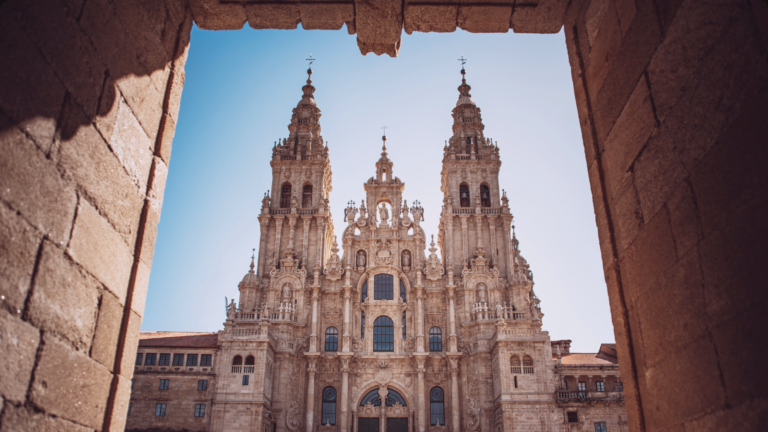
For over a thousand years, pilgrims have walked hundreds of kilometres to reach this moment: standing before the Baroque façade of Santiago de Compostela Cathedral, having completed the Camino de Santiago.
But even if you didn’t walk, the interior rewards.
Behind the Baroque exterior lies a Romanesque core from the 11th century — one of the best-preserved in Spain.
The Pórtico de la Gloria (Portal of Glory) features 200 carved figures representing the Apocalypse.
The tomb of St. James draws millions of faithful.
And the famous Botafumeiro — a giant incense burner that swings across the transept during special masses — is pure medieval theatre.
Thinking about walking the Camino yourself? Start with our Camino de Santiago beginner’s guide — it covers everything from routes to packing lists.
Practical stuff:
- Entry: Cathedral entrance is free — the museum and rooftop tours cost extra (around €12-15)
- Rooftop tour: Highly recommended — walk across the cathedral roof for unforgettable city views
- Botafumeiro: Not swung daily — check the schedule if you want to witness it
- Pilgrims: If you’ve walked the Camino, attend the Pilgrim Mass (usually 12pm daily) for the full emotional experience
Pro tip: Visit early morning before tour groups arrive, or evening when the light is golden.
Legend has it: St. James’s remains were transported here from Jerusalem by a boat guided by angels — whether you believe it or not, the faith is palpable.
Book Santiago de Compostela rooftop tour →
8. Palma Cathedral, Mallorca — The Seaside Giant With Gaudí’s Touch

Rising dramatically above Palma’s harbour, La Seu (as locals call it) is one of Europe’s most striking cathedral silhouettes.
But step inside and it gets even better — because this isn’t just a Gothic cathedral.
It’s a Gothic cathedral with contributions from Antoni Gaudí and contemporary artist Miquel Barceló.
Gaudí redesigned the main altar and lighting in the early 20th century, adding a floating canopy of lamps and moving the choir to create an unobstructed nave.
Barceló’s modern ceramic installation in the Chapel of the Holy Sacrament (added in 2007) is controversial but breathtaking — a polychrome sea of fish and loaves that seems to spill from the walls.
It’s medieval grandeur meets contemporary art, and somehow it works.
If you’re visiting Mallorca, check out our guide to Palma de Mallorca in 24 hours to make the most of your trip.
Practical stuff:
- Entry: Around €9 general admission — includes audio guide
- Hours: Monday-Friday 10am-2:15pm (closes early!) — Saturday varies — check before visiting
- The rose window: At 11.5 metres across, it’s one of the largest in the world — on certain days (November 11, February 2), the light aligns to project a “figure of 8” on the opposite wall
Pro tip: The cathedral closes in the afternoon, so make this a morning visit — combine with exploring Palma’s old town.
Architectural trivia: Palma Cathedral has the highest nave of any Gothic cathedral in Spain at 44 metres — taller than Notre-Dame.
Book Palma Cathedral tickets →
Plan Your Spanish Church Tour
Want to see several of these beauties in one trip?
Here’s how to connect them.
By Train
Spain’s high-speed AVE network makes church-hopping surprisingly easy.
Consider a Spain Rail Pass
If you’re visiting 3+ cities, a Eurail Spain Pass might save you money — especially for longer distances like Madrid to Seville or Barcelona to Santiago.
Don’t Forget Travel Insurance
Cathedrals have stood for centuries — but flight delays haven’t.
Keep Exploring Spain
Loved these churches?
Here’s more Spanish beauty waiting for you:
- Spain’s Most Breathtaking Moorish Architecture — More of that Islamic-Christian fusion
- Insanely Beautiful Spanish Castles — Another dose of medieval grandeur
- 14 Medieval Villages in Spain — Cobblestones and history
- Spain’s Most Spectacular Roman Ruins — Go even further back in time
- 10 Epic Places in Spain — The ultimate bucket list
- The Camino de Santiago: A Beginner’s Guide — Walk to Santiago yourself
The Bottom Line
Spain’s churches aren’t just places of worship — they’re time capsules, art galleries, and architectural marvels rolled into one.
Whether it’s the intimate, fresco-covered ceiling of Valencia’s San Nicolás or the soaring, light-filled nave of León, each one offers something you simply can’t experience anywhere else.
The best part?
Unlike crowded museums where you’re shuffled past masterpieces in seconds, these spaces let you linger.
Sit in a pew.
Watch the light change.
Let the silence settle around you.
Some things require time to truly appreciate — and these interiors are definitely on that list.
So next time you’re in Spain, skip the tourist traps and step into one of these sacred spaces instead.
Your soul (and your Instagram) will thank you.
Which Spanish church interior blew your mind?
Or have you discovered a hidden gem we missed?
Tell us in the comments — we’re always hunting for the next jaw-dropping ceiling.
Related Posts You’ll Love:
- Spain’s Most Breathtaking Moorish Architecture
- Insanely Beautiful Spanish Castles
- 14 Medieval Villages in Spain
Bookmark this post — you’re going to need it.