Spain’s Most Awe-Inspiring Cathedrals That Will Leave You Speechless
Spain doesn’t just have cathedrals—it has over 90 of them, and virtually every single one is a masterpiece in its own right.
This is a country where cathedral-building wasn’t just about religion—it was about power, prestige, and pushing the limits of what stone, glass, and human ambition could achieve.
From Gothic spires that seem to pierce heaven itself to Romanesque fortresses of faith, from Moorish-influenced hybrids found nowhere else to Gaudí’s otherworldly vision still rising in Barcelona, Spain’s sacred architecture is genuinely world-class.
These buildings tell the story of Spain itself: the slow reconquest from the Moors, the wealth that poured in from the Americas, and the regional rivalries that pushed each city to outdo its neighbors.
Whether you’re a believer seeking spiritual connection or simply someone who appreciates when humans build something magnificent, these cathedrals will move you.
Ready to look up in wonder?
1. Sagrada Família, Barcelona
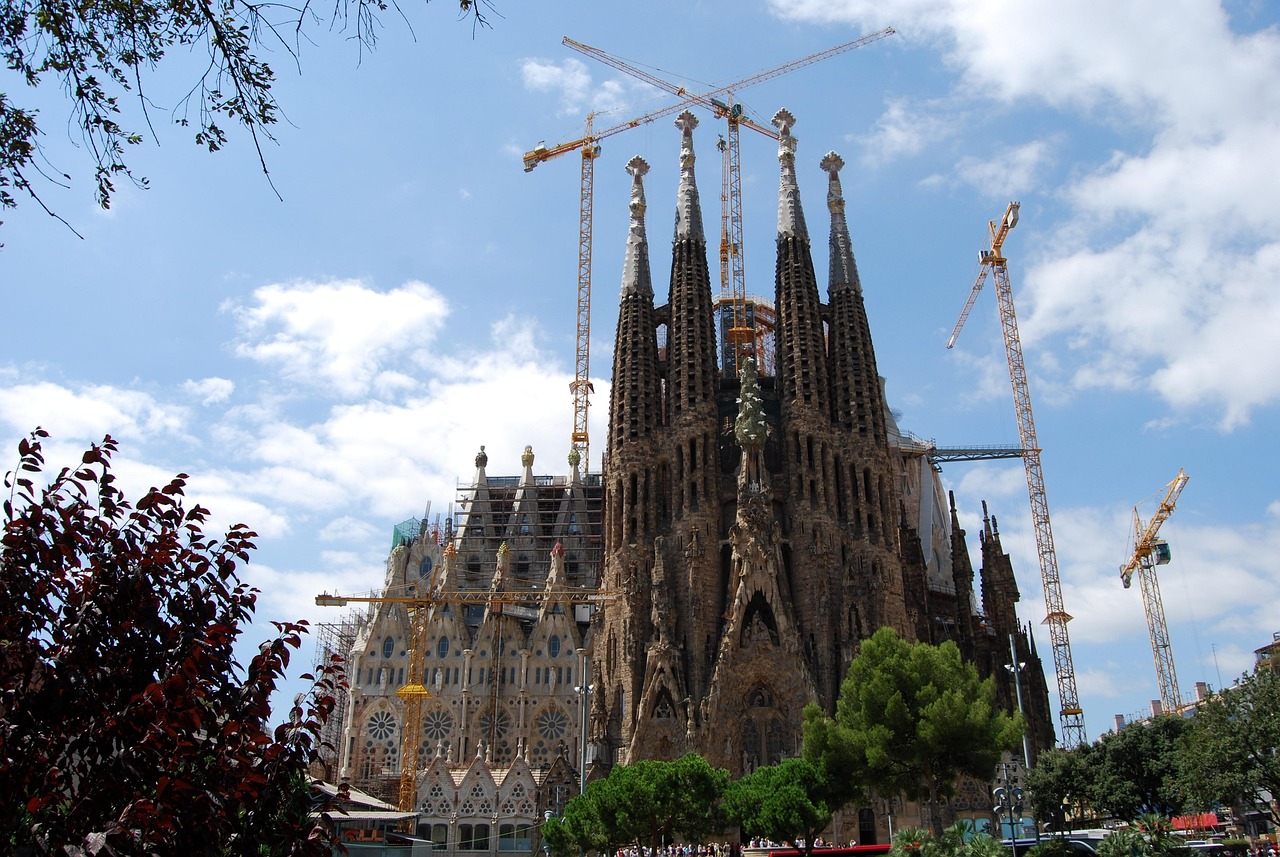
Technically a basilica rather than a cathedral, but try telling that to anyone who’s stood beneath Gaudí’s still-unfinished masterpiece.
Construction began in 1882 and continues today, making this perhaps the most ambitious building project on Earth—a Gothic concept reimagined through the lens of pure genius.
The interior is unlike any church ever built: tree-like columns branch toward a ceiling that filters light through stained glass in ways that seem almost supernatural.
Gaudí designed every element using natural forms and mathematical principles, creating spaces that feel organic despite being carved from stone and concrete.
The facades tell the story of Christ’s life in sculpture that ranges from traditional religious imagery to abstract modernist interpretation.
UNESCO recognized the Sagrada Família as a World Heritage Site even though it won’t be completed until at least the 2030s.
Book tickets well in advance and consider the tower visits—ascending into Gaudí’s vision adds another dimension to an already transcendent experience.
2. Burgos Cathedral
This is the only Spanish cathedral recognized by UNESCO entirely on its own merits—not as part of a historic city center, but as a standalone masterpiece of human achievement.
Built between 1221 and 1567, Burgos Cathedral represents the complete history of Gothic art in one building, from pure French-influenced beginnings to elaborate late Gothic flourishes.
The exterior is dominated by two delicate spires designed by Johannes von Köln in the 15th century, creating a silhouette that defines the city skyline.
Inside, the Chapel of the Constable is so extravagantly decorated it’s almost obscene—a riot of gold, carved stone, and artistic excess that took decades to complete.
El Cid, Spain’s legendary warrior, is buried here alongside his wife Jimena, adding historical weight to architectural magnificence.
Don’t miss the Papamoscas—a mechanical figure that opens its mouth and moves its arm every time the clock strikes the hour.
Burgos was capital of the kingdoms of León and Castile, and this cathedral was built to announce that power to the world.
3. Seville Cathedral
This is the largest Gothic cathedral in the world and the third-largest church of any kind, covering 11,520 square meters of sacred space.
The builders’ goal, reportedly, was to construct something so magnificent that future generations would think they were mad—and they succeeded.
Built on the site of Seville’s former Great Mosque, the cathedral incorporates the Giralda—the mosque’s 12th-century Almohad minaret—as its bell tower.
The ascent to the top of the Giralda follows 35 ramps rather than stairs, designed so guards could ride horses to the summit.
Inside, the main altarpiece took 82 years to complete and contains 45 carved scenes from the life of Christ covered in gold.
Christopher Columbus is buried here (probably—the location of his remains is disputed), with an elaborate tomb carried by statues representing the four kingdoms of Spain.
The Patio de los Naranjos, the orange-tree courtyard from the original mosque, provides a peaceful contrast to the overwhelming interior.
4. Santiago de Compostela Cathedral
The final destination of the Camino de Santiago pilgrimage, this cathedral has drawn millions of pilgrims across centuries to venerate the tomb of Saint James.
The Romanesque Pórtico de la Gloria, with over 200 carved figures, is one of the greatest achievements of medieval sculpture anywhere in the world.
The main facade facing the Plaza del Obradoiro is pure Baroque drama, added in the 18th century to protect the earlier Romanesque entrance.
Watching pilgrims arrive in the square after weeks or months of walking—crying, embracing, collapsing in exhaustion and joy—is one of Spain’s most moving spectacles.
The Botafumeiro, an enormous incense burner swung across the transept during special masses, requires eight men to operate and reaches speeds of nearly 70 kilometers per hour.
UNESCO designated both the cathedral and the historic city center as World Heritage Sites in 1985.
Even if you haven’t walked the Camino, standing where millions of pilgrims have completed their journey creates a powerful connection to history.
5. León Cathedral
Known as the “House of Light,” León Cathedral has 1,800 square meters of stained glass windows—making it the most luminous Gothic cathedral in Spain.
When sunlight streams through these medieval windows, the interior transforms into a kaleidoscope of color that genuinely takes your breath away.
The architectural style is the purest French Gothic in Spain, with soaring walls that seem too thin to support their weight.
Unlike many Spanish cathedrals that added elaborate Baroque elements, León remained relatively unchanged, preserving its Gothic purity.
The main rose window above the western entrance is a masterpiece of medieval glasswork, depicting scenes from the Last Judgment.
León sits on the Camino de Santiago, and for medieval pilgrims, entering this cathedral after days walking the Meseta plateau must have felt like entering heaven itself.
The cathedral is currently undergoing restoration of its stained glass, but enough remains visible to understand why León earned its luminous nickname.
6. Mosque-Cathedral of Córdoba
There is nowhere else on Earth quite like the Mezquita—a place where Islamic architecture and Christian worship coexist in uneasy but mesmerizing tension.
The hypostyle hall with its 856 columns and endless red-and-white striped arches creates one of the most photographed interiors in Spain.
Originally the Great Mosque of Córdoba, the building was converted to a cathedral after the Christian reconquest but retained its Islamic architecture.
In the 16th century, a full Renaissance cathedral was built directly inside the mosque, creating a bizarre collision of styles that even King Charles V regretted.
The mihrab—the prayer niche indicating the direction of Mecca—features Byzantine mosaics created by craftsmen sent by the Emperor in Constantinople.
Walking through the forest of columns, you understand why Córdoba was once the most advanced city in Western Europe.
UNESCO recognized the Mezquita as a World Heritage Site, part of the historic center of a city that was the heart of Islamic Spain.
7. Toledo Cathedral
Often called the “Dives Toletana” (Rich Toledana), this cathedral houses one of Spain’s greatest collections of art and treasure.
The sacristy alone contains works by El Greco, Velázquez, Goya, and other masters—essentially a museum within a cathedral.
Construction began in 1226 and continued for over 250 years, resulting in a building that shows the evolution of Gothic style in Spain.
The main altarpiece, carved in polychrome wood and gold, depicts scenes from the life of Christ in extraordinary detail.
The Transparente—an 18th-century Baroque altar lit dramatically from above through a hole cut in the Gothic ceiling—is either a masterpiece or a travesty, depending on your perspective.
Toledo was Spain’s religious capital, and the cathedral reflects the wealth and power the Church wielded at its peak.
The cathedral anchors a UNESCO World Heritage city where Christian, Muslim, and Jewish heritage blend in every street.
8. Ávila Cathedral
This is the first Gothic cathedral in Spain, and its unique feature is impossible to miss: the apse is built directly into the city’s famous medieval walls.
The “cimorro”—the rounded fortified apse—served as one of the defensive towers protecting the city, making this both sacred space and military stronghold.
Construction began in the 12th century, making Ávila Cathedral earlier and consequently more austere than later Gothic extravaganzas.
The main portal resembles those of the great French cathedrals, showing the influence that spread south during the Reconquista.
Inside, a 16th-century cloister provides peaceful respite from the massive stone volumes of the main church.
UNESCO included the cathedral in its World Heritage designation of Ávila’s old town and its extramural churches.
The combination of religious and military architecture is unique in Spain and creates genuinely dramatic photographs from outside the walls.
9. Segovia Cathedral
Known as “The Lady of Cathedrals” for its elegant proportions, this is one of the last Gothic cathedrals built in Spain—and arguably the most beautiful.
Constructed between the 16th and 18th centuries, long after Gothic style had passed elsewhere, Segovia Cathedral represents the style’s swan song.
The 88-meter bell tower dominates the skyline alongside the famous Roman aqueduct and the Alcázar, creating one of Spain’s most photographable cityscapes.
Inside, 157 stained glass windows flood the interior with colored light, while the exterior is crowned with pinnacles where storks nest at sunset.
The apse presides directly over the Plaza Mayor, creating an intimate relationship between sacred and civic space.
UNESCO recognized the cathedral as part of the historic city and aqueduct World Heritage Site in 1985.
Climbing the tower for views over Segovia’s terracotta rooftops is one of the city’s essential experiences.
10. Teruel Cathedral
This cathedral is the crown jewel of Spanish Mudéjar architecture—a style that exists nowhere else in the world.
The ceiling, covered in intricate painted woodwork, has been called the “Sistine Chapel of Mudéjar art” for its extraordinary beauty.
Mudéjar was created when Christian patrons hired Muslim craftsmen after the Reconquista, resulting in a unique blend of Islamic decoration and Christian function.
The bell tower, the dome, and especially that astonishing ceiling represent the peak of this distinctive Aragonese tradition.
UNESCO recognized Teruel’s Mudéjar architecture—including the cathedral—as a World Heritage Site in 1986.
The town of Teruel itself is overlooked by most tourists, meaning you can often appreciate this extraordinary building in relative solitude.
Geometry, color, and craftsmanship combine here in ways that prove the beauty of cross-cultural artistic exchange.