10 Roman Ruins in Spain That Rival Anything in Italy
Here’s something most travelers don’t realize: Spain has some of the best-preserved Roman ruins in the entire Mediterranean.
We’re talking about aqueducts that still look like they could carry water, theaters that still host performances, and entire city grids that haven’t been buried under modern development.
For seven centuries, this was Hispania — one of Rome’s most important provinces, source of emperors, silver, and the fermented fish sauce called garum that Romans couldn’t live without.
The legions left behind roads, bridges, walls, and monuments that have survived nearly two millennia of earthquakes, invasions, and urban sprawl.
Today, you can walk through Roman streets, stand in amphitheaters where gladiators fought, and marvel at engineering so perfect it defies belief.
Ready to discover the Rome that lies hidden in Spain?
Quick Picks: Find Your Perfect Ruins
📸 For the iconic shot: Aqueduct of Segovia — 167 arches of gravity-defying granite
🎭 For living history: Roman Theatre of Mérida — still hosts performances after 2,000 years
🌊 For ruins with a view: Tarragona Amphitheater — gladiator arena overlooking the Mediterranean
🎬 For Game of Thrones fans: Itálica — the Dragonpit, plus emperor birthplaces and stunning mosaics
🚶 For a unique walk: Roman Walls of Lugo — stroll the only complete Roman walls on Earth
🏖️ For beach lovers: Baelo Claudia — ancient ruins meet Atlantic waves
1. Aqueduct of Segovia

This is the Roman structure that makes everyone gasp — 167 arches of golden granite rising up to 28.5 meters high, cutting through the heart of a modern city like a message from the ancient world.
Built around 50 AD to bring water from the Sierra de Guadarrama mountains, the aqueduct stretches 813 meters through Segovia’s Plaza del Azoguejo.
Here’s the engineering miracle: the entire structure is held together by nothing but gravity — no mortar, no cement, just precisely cut blocks of granite stacked with mathematical perfection.
The aqueduct continued functioning until the 19th century, carrying water along a 17-kilometer system that included underground channels and settling tanks.
At the Plaza del Azoguejo, where the aqueduct reaches its maximum height, the double tier of arches creates one of the most photographed scenes in Spain.
UNESCO recognized the aqueduct and Segovia’s old town as a World Heritage Site, though honestly, this structure would deserve protection even if it stood alone in a desert.
Segovia is an easy day trip from Madrid — and while you’re there, don’t miss the fairy-tale Alcázar, one of Spain’s most insanely beautiful castles.
Best time to visit: Early morning or sunset, when the golden stone seems to glow from within.
Book a Segovia day trip from Madrid →
2. Roman Theatre of Mérida

If you could visit only one Roman site in Spain, many experts would send you here — the most impressive Roman theater in the entire Iberian Peninsula.
Built between 16 and 15 BC under the patronage of Augustus’s general Agrippa, this theater seated 6,000 spectators and was the cultural heart of Augusta Emerita.
The two-story stage wall, or frons scenae, has been beautifully restored, with Corinthian columns and statues of gods creating a backdrop that still impresses today.
Every summer, the theater returns to its original purpose during the International Festival of Classical Theatre, when actors perform Greek and Roman plays in this 2,000-year-old venue.
Adjacent to the theater sits the amphitheater, where 15,000 spectators once watched gladiatorial combat — now more ruined but still viscerally impressive.
Mérida was the capital of Lusitania, one of Rome’s most important western provinces, and this theater was built to broadcast that power.
The National Museum of Roman Art nearby, designed by architect Rafael Moneo, houses an exceptional collection that provides context for everything you’ll see outside.
Mérida is one of Spain’s most underrated destinations — most tourists skip Extremadura entirely, which means you’ll have these incredible ruins practically to yourself.
Pro tip: If you visit in July or August, book tickets for the Classical Theatre Festival — seeing a play here is unforgettable.
Book Mérida Roman sites tour →
3. Tarragona Amphitheater

Built directly into a cliff overlooking the Mediterranean, this 2nd-century amphitheater offers something Rome itself can’t: sea views behind the arena where gladiators fought.
The amphitheater once held up to 14,000 spectators who came to watch blood sports with the blue Mediterranean as their backdrop.
Tarragona — ancient Tarraco — was the capital of Tarraconensis, Rome’s largest province in Hispania, making it one of the most important cities in the western empire.
The ruins of a Visigothic church and later medieval chapel inside the arena show how the site was repurposed through the centuries.
Above the amphitheater, the old town is built directly on Roman foundations, with chunks of the ancient circus appearing between modern buildings.
The city walls include sections dating to the 3rd century BC, making them some of the oldest Roman fortifications outside Italy.
A short drive outside town, the Les Ferreres Aqueduct — also called the Devil’s Bridge — stands 27 meters high and can actually be walked across.
Tarragona makes an easy day trip from Barcelona — check out our guide to 14 must-visit spots in Barcelona to plan the rest of your trip.
Pro tip: Combine the amphitheater with the Roman circus ruins and the Passeig Arqueològic walk along the ancient walls.
Book Tarragona day trip from Barcelona →
4. Itálica, Seville Province
Just 20 minutes from Seville lies the birthplace of emperors Trajan and Hadrian — and one of Spain’s most complete Roman archaeological sites.
Founded in 206 BC by Scipio Africanus for veterans of the Second Punic War, Itálica was one of the first Roman cities established outside Italy.
The massive amphitheater here was the third-largest in the Roman Empire, capable of seating 25,000 spectators — and Game of Thrones used it as the Dragonpit in the series finale.
But the real treasures are the mosaics: elaborate floors featuring birds, sea creatures, and geometric patterns that have survived remarkably intact.
You can walk along Roman streets, past the foundations of grand houses, and imagine life in a city that produced two of Rome’s most capable emperors.
Because Itálica was eventually abandoned rather than built over, archaeologists have been able to excavate extensively without destroying modern buildings.
This is Roman Spain without the tourist crowds — even on busy days, you’ll have space to explore at your own pace.
While you’re in the area, Seville itself is Spain’s most colorful city — plan to spend at least a couple of days exploring.
Pro tip: Visit the House of the Birds for the best-preserved mosaics, and bring water — there’s little shade in summer.
Book Itálica tour from Seville →
5. Roman Walls of Lugo

These are the only Roman walls in the world that remain completely intact around an entire city — 2.2 kilometers of 3rd-century fortifications still standing after 1,700 years.
Built during the late Roman period to protect the city from Germanic invasions, the walls rise 10 to 15 meters high and average 4.2 meters thick.
Nearly 100 towers originally punctuated the circuit, with about half remaining in good condition today.
What makes Lugo unique is that you can walk the entire perimeter on top of the walls — and locals do exactly that, treating the ramparts as a pedestrian pathway.
The walkway is broad enough to feel like a street, with views into both the old town and the surrounding countryside.
Ten gates pierce the walls, though only five are original — the rest were added in later centuries as the city’s needs changed.
UNESCO recognized the walls as a World Heritage Site, calling them the finest example of late Roman fortifications in Western Europe.
Lugo sits along the Camino Primitivo route — if you’re considering walking to Santiago, check out our Camino de Santiago beginner’s guide.
Pro tip: Walk the walls at sunset when the stone glows golden, then reward yourself with Lugo’s famous pulpo (octopus) in the old town.
6. Roman Bridge of Alcántara
Spanning the Tagus River in Extremadura, this 2nd-century bridge is considered the masterpiece of Roman engineering in Spain.
Built of granite blocks without mortar — like the Segovia aqueduct — the bridge rises 48 meters above the river and stretches 194 meters across.
An inscription records that the architect was Gaius Julius Lacer, and a small temple at one end was dedicated to the emperor Trajan.
The central arch alone spans 28 meters, and the bridge has survived floods, earthquakes, and deliberate destruction during various wars.
The name Alcántara comes from the Arabic “al-qanṭara,” meaning “the bridge” — even to the Moors who conquered Spain seven centuries later, this structure needed no other name.
Modern visitors can walk across the bridge, drive across it, and marvel that something built before the fall of Rome still handles modern traffic.
Combined with the nearby Roman town of Cáparra and its famous arch, this corner of Extremadura offers a concentrated dose of Roman heritage.
Extremadura is full of hidden treasures — for more off-the-radar Spain, explore our guide to underrated Spanish destinations.
Pro tip: The bridge is most dramatic at sunset, with the golden stone reflected in the Tagus below.
Find hotels in Cáceres (nearest city) →
7. Roman Theatre of Cartagena

This theater lay buried under neighborhoods for centuries until excavations in 1988 revealed one of the best-preserved Roman theaters in the country.
Built between 5 and 1 BC under Augustus, the theater could seat 7,000 spectators facing views of the harbor that made Cartago Nova one of Rome’s most important ports.
Ingenious modern museum design takes visitors through the excavations before emerging into the theater itself, creating a journey from discovery to wonder.
The recovery of this site required demolishing a 20th-century market and a church, revealing the layers of history that had accumulated over two millennia.
Cartagena was founded by the Carthaginians and captured by Scipio Africanus in a brilliant assault — making it one of the oldest continuously inhabited cities in Spain.
The surrounding archaeological zone includes Roman baths, a forum, and sections of city wall that show the extent of ancient Cartago Nova.
This is an example of urban archaeology at its best, where ancient and modern coexist in fascinating layers.
Fun fact: Cartagena also has one of Spain’s most beautiful Art Nouveau train stations — see it in our guide to 12 jaw-dropping train stations in Spain.
Pro tip: Buy the combined ticket that includes the theater, forum, and other Roman sites for the best value.
8. Segóbriga, Cuenca Province
This genuinely off-the-beaten-path Roman city offers something rare: the chance to explore ancient ruins almost entirely alone.
Located in the province of Cuenca, Segóbriga was an important mining center, extracting the translucent gypsum called lapis specularis that Romans used for windows.
The site includes a well-preserved theater and amphitheater, baths, a forum, and city walls — essentially a complete small Roman city.
Because it’s located away from major tourist routes, you might find yourself as the only visitor walking these ancient streets.
The theater is particularly impressive, with most of its seating intact and views across the Castilian plateau.
An interpretation center explains the site’s history and displays artifacts found during excavations.
For anyone seeking Roman Spain without crowds, Segóbriga rewards the journey with authentic atmosphere and genuine solitude.
This area of Spain is full of surprises — for more hidden gems, check out Spain’s 10 most unbelievable destinations.
Pro tip: Bring a picnic — there’s nowhere to eat nearby, but the setting is perfect for lunch among the ruins.
9. Baelo Claudia, Cádiz Province
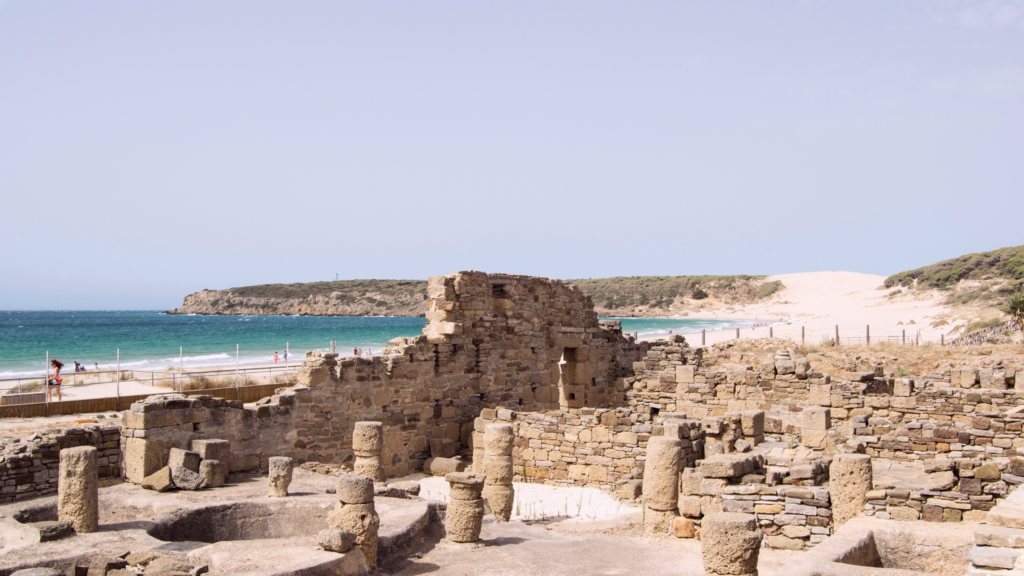
Sitting directly on the Costa de la Luz with views toward Africa, this Roman fishing town offers ancient ruins with Atlantic breezes and crashing waves.
Baelo Claudia was famous throughout the empire for its garum — the fermented fish sauce that Romans added to virtually everything.
The site preserves the fundamental layout of a classical Roman town: the forum, basilica, temples, theater, baths, and an entire factory quarter for processing fish.
The beach location is spectacular, with pristine sand meeting the ruins of civilization that thrived here 2,000 years ago.
The factory buildings with their stone vats for fermenting fish provide visceral insight into an industry that seems bizarre today but was essential to Roman cuisine.
A modern museum on site displays artifacts and explains daily life in this prosperous coastal town.
The nearby beach of Bolonia is one of the most beautiful in Andalusia — making this an easy combination of culture and coast.
If you’re a beach lover, don’t miss our guide to Spain’s strange but stunning beaches and Spain’s most secret beaches.
Pro tip: Visit in late afternoon, explore the ruins, then watch the sunset from Bolonia beach — one of Spain’s best beach experiences.
10. Empúries, Catalonia
This site on the Costa Brava is unique in Spain: the remains of an ancient Greek colony sitting directly beside a Roman city.
Greeks from Phocaea founded Emporion in the 6th century BC, and the town flourished as a trading port before the Romans arrived in 218 BC.
You can walk from the Greek town — with its agora, temples, and city walls — directly into the adjacent Roman city, experiencing two different ancient civilizations in one visit.
The Roman mosaics here are exceptional, with intricate geometric and figured designs that have survived remarkably intact.
The setting, on cliffs above the Mediterranean, adds natural beauty to historical significance.
A museum on site displays sculptures, pottery, and everyday objects from both Greek and Roman periods.
Empúries offers something no other site in Spain can match: a direct physical comparison of how two great Mediterranean civilizations built their cities.
The Costa Brava has much more to offer — combine Empúries with 14 must-visit spots in Barcelona for the perfect Catalonia itinerary.
Pro tip: The beach below the ruins is excellent for swimming — bring your suit and make a day of it.
Book Empúries tour from Barcelona →
Find hotels on the Costa Brava →
Plan Your Roman Spain Adventure
Ready to walk in the footsteps of emperors?
Here’s how to connect these ancient sites.
By Train
Spain’s rail network connects most major Roman sites easily.
Consider a Spain Rail Pass
Visiting multiple sites across the country? A Eurail Spain Pass might save you money — especially useful for reaching Mérida, Lugo, and other off-the-beaten-path destinations.
By Car
Some sites (Segóbriga, Baelo Claudia, Alcántara) are best reached by car.
Don’t Forget Travel Insurance
Ruins have survived millennia — but travel plans are more fragile.
Keep Exploring Spain
Loved these Roman ruins?
Here’s more ancient and historic Spain waiting for you:
- 8 Spanish Churches That Prove Medieval Architects Were Wizards — Where faith meets impossible beauty
- Spain’s Most Breathtaking Moorish Architecture — What came after the Romans
- Insanely Beautiful Spanish Castles — Medieval fortresses and fairy tales
- 14 Medieval Villages in Spain — Cobblestones and timeless charm
- 10 Epic Places in Spain — The ultimate bucket list
- These Spanish Villages Were Abandoned — Haunting beauty frozen in time
The Bottom Line
Spain’s Roman heritage rivals anything you’ll find in Italy — often with fewer crowds and equally stunning preservation.
From the gravity-defying arches of Segovia to the seaside ruins of Baelo Claudia, these sites tell the story of seven centuries when Hispania was one of the most important corners of the Roman world.
The best part?
You can still walk these ancient streets, sit in these theaters, and cross these bridges — experiencing history not behind glass, but underfoot.
So skip the crowded Colosseum.
Book a flight to Spain instead.
The emperors would approve.
Which Roman site in Spain blew your mind?
Or have you discovered ruins we missed?
Tell us in the comments — we’re always hunting for the next archaeological treasure.
Related Posts You’ll Love:
- 8 Spanish Churches That Prove Medieval Architects Were Wizards
- Spain’s Most Breathtaking Moorish Architecture
- Insanely Beautiful Spanish Castles
Bookmark this post — you’re going to need it.