Spain’s Most Instagrammable Doorways
Spanish doors tell stories.
Centuries of Moorish, Gothic, Renaissance, and Baroque influence have left Spain with some of the most photogenic entrances on earth.
Massive wooden doors studded with iron nails guard palace courtyards.
Horseshoe arches frame mysterious passages into ancient mosques.
Art Nouveau masterpieces drip with organic metalwork that looks like something from a fever dream.
Here’s where to find the doorways that will absolutely wreck your Instagram feed.
The Doors of the Royal Alcázar, Seville
The Alcázar has been a royal residence for over 700 years, and its doors reflect every era.
The main entrance — the Puerta del León — features a stunning lion tile panel above a massive wooden door studded with brass.
Inside, horseshoe arches lead to courtyards, and every turn reveals another photogenic doorway.
The Patio de las Doncellas has arched doorways surrounded by intricate stucco work and azulejo tiles.
The Ambassadors’ Hall entrance is jaw-dropping — golden honeycomb ceilings visible through ornate frames.
Pro tip: the secret tunnel-like passage in the far corner of the Patio de Banderas (the square outside) is far less crowded than the main entrances and equally photogenic.
Arrive before 9 AM to have these doorways to yourself.
The Mezquita Doors, Córdoba
The Great Mosque of Córdoba has 19 doors, each one more stunning than the last.
The Puerta del Perdón (Door of Forgiveness) is the main entrance — a towering horseshoe arch decorated with intricate geometric patterns.
But the side doors are equally impressive and far less photographed.
The bronze-clad doors feature Moorish inscriptions and patterns that have survived since the 10th century.
The contrast between the Islamic architecture and the Catholic additions creates doorways that span civilizations.
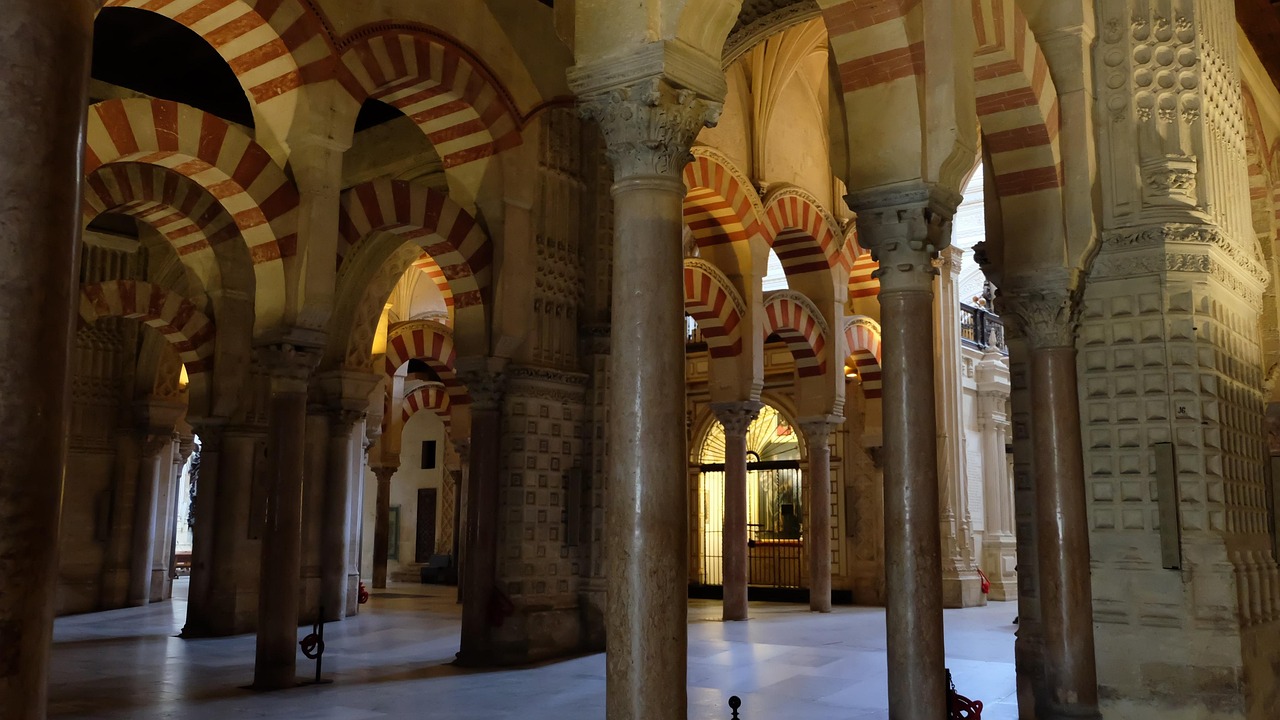
Visit during the morning when light streams through the forest of red-and-white arches inside.
Casa Batlló’s Dragon Door, Barcelona
Gaudí’s masterpiece on Passeig de Gràcia has a main entrance that looks like it leads to another dimension.
The organic ironwork curves and flows like underwater plants.
The stained glass panels above filter light into impossible colors.
The whole facade is designed to look like the scales of a dragon, and the doorway is the beast’s mouth.
Even if you don’t go inside (tickets are €35+), the exterior is free to photograph.
Early morning or late evening offers the best light and smallest crowds on this extremely busy street.
The Blue Doors of Frigiliana
This white village in Málaga province is famous for its stunning blue doors contrasting against whitewashed walls.
Potted plants flank nearly every entrance.
Bougainvillea cascades over doorframes.
The Moorish influence is visible in the horseshoe shapes and geometric patterns carved into many doors.
Frigiliana has won Spain’s “prettiest village” award multiple times, and its doorways are a major reason why.
Wander the steep, narrow streets and you’ll find dozens of Instagram-worthy shots.
The ceramic street signs are handpainted and make excellent complements to door photos.
Puerta de los Apóstoles, Valencia Cathedral
Valencia’s cathedral has three major doorways, each in a different architectural style.
The Puerta de los Apóstoles (Door of the Apostles) is the most photographed — a Gothic masterpiece with 14 stone figures arranged around a pointed arch.
Every Thursday at noon, the Water Tribunal has met in front of this door for over 1,000 years to settle irrigation disputes.
It’s the oldest continuously functioning court in Europe, and watching the proceedings adds meaning to your photos.
The contrast between the weathered stone and the intricate carvings creates images that look centuries old.
The Patios of Córdoba
During the Festival de los Patios in May, Córdoba opens hundreds of private courtyard doors to the public.
But year-round, you can spot participating patios by the potted plants flanking their entrances.
These doors are wooden, often painted blue or green, covered in ironwork, and framed by geraniums, jasmine, and bougainvillea.
The contrast between the humble exterior and the explosion of color inside is part of the magic.
Some patios remain open year-round — the tourist office provides maps.
Even the closed doors, festooned with plants and tiles, make stunning photos.
Mudéjar Doors of Seville
Mudéjar architecture — the fusion of Islamic and Christian styles — produced some of Spain’s most distinctive doorways.
The Chapel of San Bartolomé in Córdoba has Mudéjar stone doorways considered jewels of the style.
In Seville, churches like San Marcos, Santa Marina, and Santa Catalina feature doors that blend horseshoe arches with Christian imagery.
Casa de Pilatos has Mudéjar arches throughout, including the chapel entrance that perfectly captures the blend of cultures.
These doors tell the story of a Spain where different religions coexisted — and created something beautiful together.
The Doors of Toledo
Toledo was the capital of Visigothic Spain and later a center of Islamic and Jewish culture.
Every civilization left its mark on the city’s doors.
The Puerta del Sol is a Mudéjar city gate with two massive towers flanking an ornate arch.
The Cathedral’s main door is pure Gothic drama, with carved stone saints watching over visitors.
Synagogue doors, mosque entrances, church portals — they’re all within walking distance in this compact hilltop city.
The narrow streets create perfect framing for doorway photos.
Art Nouveau Doorways of Barcelona’s Eixample
Barcelona’s Eixample district is essentially an open-air museum of Modernisme architecture.
Even “ordinary” apartment buildings feature curved ironwork balconies, carved wooden doors, and organic decorative elements.
Casa Amatller’s door — designed by Puig i Cadafalch — features medieval-inspired ironwork and ceramic details.
The Hospital de Sant Pau has ceramic-framed doorways that explode with color.
Walk the side streets off Passeig de Gràcia and you’ll find dozens of stunning entrances that tourists walk right past.
The doorways of the Eixample prove that Art Nouveau wasn’t just for monuments — it was for everyday life.
How to Photograph Spanish Doors
Morning light is generally best, especially for east-facing doors.
Overcast days can be perfect — the diffused light eliminates harsh shadows and brings out colors.
Include context: potted plants, ceramic tiles, cobblestones.
Step back far enough to capture the full frame and surrounding architecture.
Visit on weekdays to avoid crowds in popular areas.
Most importantly: be respectful.
Many of these doors lead to private homes.
Don’t block entrances, don’t peer inside, and definitely don’t knock expecting to be let in.
Spanish doorways aren’t just photo opportunities.
They’re windows into centuries of history — Moorish caliphs, Catholic kings, Art Nouveau dreamers, and the everyday people who passed through them.
Every door tells a story.
Your job is just to capture it.