Spain’s Most Accessible Peaks You Can Summit Without Technical Gear
You don’t need ropes, ice axes, or a death wish to stand on top of Spain’s most spectacular mountains.
This country has an incredible selection of peaks where regular hikers—not just elite mountaineers—can experience the life-changing thrill of reaching a genuine summit.
We’re talking about mountains that pierce the 3,000-meter barrier, offer panoramic views stretching to Africa, and deliver that unmistakable sense of accomplishment that only standing on a peak can provide.
Yes, these climbs require fitness, preparation, and respect for mountain conditions.
But if you can handle a long hike with significant elevation gain, Spain’s highest points are waiting for you.
Here’s your guide to summits that’ll change how you see yourself—and the world below.
1. Mulhacén (3,479m), Sierra Nevada
This is the big one—the highest peak in mainland Spain and the highest point in Western Europe outside the Alps.
And here’s the incredible news: the south flank of Mulhacén is gentle and presents no technical challenge whatsoever.
That’s right—the highest mountain in the Iberian Peninsula is essentially a walker’s peak, accessible to anyone with decent fitness and proper preparation.
From Capileira in the Alpujarras, a summer bus service climbs to the Mirador de Trevélez at 2,700 meters, reducing the summit to roughly a 6-hour round trip.
The views from the top are genuinely breathtaking—on clear days, you can see the Mediterranean coast, the Rif Mountains of Morocco, and seemingly half of Andalucía spread below you.
Be warned: at nearly 3,500 meters, altitude effects are real, and mountain weather can change rapidly even in summer.
But with proper planning, anyone in reasonable shape can stand on the roof of Spain—and that’s something special.
2. Veleta (3,396m), Sierra Nevada
Spain’s second-highest peak is arguably even more accessible than Mulhacén thanks to Europe’s highest paved road.
The road from the ski resort of Pradollano climbs to over 3,000 meters, leaving a relatively short walk to the summit along a well-marked path.
From the top, the views of Mulhacén are spectacular—and on exceptionally clear days, you can see both the Mediterranean Sea and the Atlantic Ocean simultaneously.
The summit itself is a broad, rocky plateau rather than a dramatic point, making it comfortable to linger and absorb the views.
Because of the road access, this is probably the easiest 3,000-meter peak in Spain, perfect for those wanting their first high-altitude experience.
That said, altitude is altitude—take your time, stay hydrated, and don’t underestimate the sun at these heights.
Winter transforms Veleta into a completely different proposition requiring full mountaineering skills, but summer conditions make it genuinely accessible.
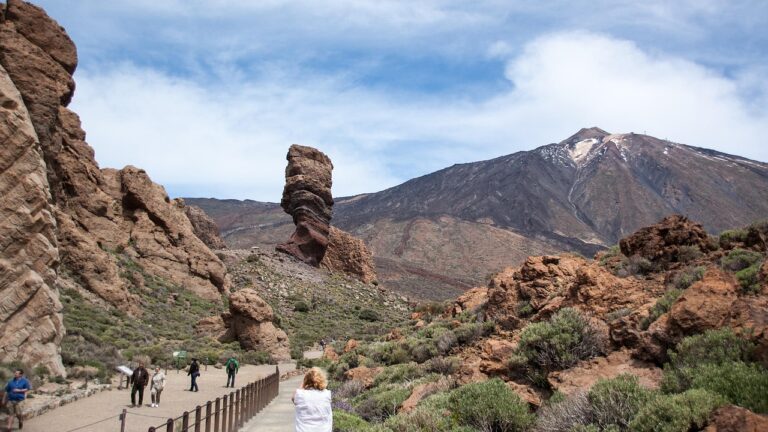
3. Pico del Teide (3,718m), Tenerife
Technically, this volcano in the Canary Islands is the highest point in all of Spain—and you can reach it with a cable car.
The Teléferico del Teide whisks visitors from 2,356 meters to 3,555 meters in just eight minutes, leaving a short but significant final climb to the crater rim.
Here’s the catch: access to the actual summit requires a free permit that must be obtained in advance through the national park authority.
The permit system limits daily visitors to protect this UNESCO World Heritage site and ensure everyone has a quality experience.
Standing in the crater of an active volcano with the Canary Islands spread below you is an absolutely surreal experience.
On the clearest days, you can see the shadow of Teide stretching across the Atlantic Ocean—a phenomenon that has to be seen to be believed.
The terrain is otherworldly, more Mars than Earth, with sulfur vents still puffing from the volcano’s depths as a reminder that this giant is merely sleeping.
4. Torre Cerredo (2,650m), Picos de Europa
The highest peak in the Cantabrian Mountains offers a non-technical route from the Jou de los Cabrones mountain hut.
This is a more serious undertaking than the Sierra Nevada peaks—expect a long day with significant scrambling over limestone terrain.
The route from Vega de Urriellu passes through some of the most spectacular scenery in the Picos, with the famous Naranjo de Bulnes (Picu Urriellu) dominating the view.
While not requiring ropes or technical equipment, this ascent demands good route-finding skills and confidence on exposed terrain.
The limestone landscape is lunar in character—silver-grey rock formations, deep sinkholes, and the dramatic spires that make the Picos de Europa unique.
Reach the summit and you’ll have conquered the highest point in a mountain range that European sailors once used as their first landfall returning from the Americas.
Consider booking a night at a mountain refuge to split the journey and fully appreciate this spectacular corner of Spain.
5. Peña Santa de Castilla (2,596m), Picos de Europa
This stunning limestone peak offers one of the most rewarding non-technical summits in the Picos de Europa.
The normal route from Vega de Comeya involves a long approach through dramatic scenery followed by a scrambly but achievable final section to the summit.
The views from the top encompass the entire Central and Western Massifs of the Picos, with the Cantabrian Sea visible to the north on clear days.
Unlike Torre Cerredo, this summit comes to a proper point, delivering that classic mountaintop feeling that photographers and peak-baggers crave.
The descent can be made via an alternative route, creating a spectacular traverse for those with the energy and experience.
Spring and autumn offer the best conditions, when the snow has melted but before or after the summer crowds arrive.
This is a proper mountain day requiring early starts and serious commitment, but the rewards match the effort.
6. Pico Posets (3,375m), Aragonese Pyrenees
Spain’s second-highest peak after Aneto offers a non-technical route that’s longer but less glacier-dependent than its taller neighbor.
The most popular approach starts from the Viados Valley, ascending through beautiful high meadows before reaching the rocky upper mountain.
At 3,375 meters, Posets delivers genuine high-altitude mountaineering without the glacial travel required for Aneto’s summit.
The views from the top are extraordinary—a 360-degree panorama of the highest Pyrenees, with Aneto’s distinctive pyramid dominating the horizon.
Several mountain refuges in the area allow multi-day approaches, reducing the daily effort and allowing acclimatization to the altitude.
The Ángel Orús and Viados refuges both offer comfortable bases for summit attempts.
For experienced mountain hikers seeking a serious but non-technical challenge, Posets hits the sweet spot perfectly.
7. Alcazaba (3,371m), Sierra Nevada
This peak forms part of the spectacular amphitheater containing Mulhacén and can be combined with Spain’s highest peak in a challenging but achievable day.
Together with Mulhacén and Puntal de la Caldera, Alcazaba forms the dramatic northern face where the Genil River is born.
The ascent from Siete Lagunas (Seven Lakes) passes some of the most beautiful high-altitude scenery in Andalucía.
At 3,371 meters, this is the fifth-highest peak in Spain but sees a fraction of the traffic that Mulhacén receives.
Ambitious hikers can link Mulhacén and Alcazaba in a long day, bagging two of Spain’s five highest peaks in a single effort.
The terrain is more rugged than Mulhacén’s south flank, requiring careful route-finding and confidence on rocky ground.
Come prepared for the altitude and enjoy views that most visitors to the Sierra Nevada never get to see.
8. Pico Perdiguero (3,221m), Aragonese Pyrenees
This shapely pyramid on the French border offers one of the finest non-technical summit experiences in the Spanish Pyrenees.
The normal route from the Benasque Valley involves crossing beautiful high meadows and ascending scree slopes to the airy summit.
Clear border-marker posts guide the way, and the views into both Spain and France are genuinely spectacular.
At 3,221 meters, this peak provides a taste of true high-mountain terrain without requiring glacier travel or technical equipment.
The approach passes numerous “ibones” (glacial lakes) that add scenic interest to an already beautiful day.
The Portillón refuge offers overnight accommodation for those wanting to break up the long day.
This is a genuine Pyrenean adventure that feels wilder and more remote than the busy approaches to the highest peaks.
9. Peña Ubiña (2,417m), Cordillera Cantábrica
Sometimes called “the Matterhorn of León,” this dramatic limestone peak offers challenging but non-technical routes in the heart of the Cantabrian Mountains.
The normal route from Puerto de la Cubilla involves a long day with some exposed scrambling near the summit.
The views stretch from the Picos de Europa to the meseta of Castile, offering perspectives on Spain’s dramatic geographic contrasts.
Unlike the more famous Picos, Peña Ubiña sees relatively few visitors, providing a genuine wilderness experience.
The mountain’s distinctive profile is visible for miles in every direction, making the summit feel particularly rewarding.
Snow can linger on the upper slopes well into early summer, so check conditions carefully before attempting the ascent.
For those seeking challenging hiking away from the crowds, Peña Ubiña delivers magnificently.
10. Pica d’Estats (3,143m), Catalan Pyrenees
The highest peak in Catalonia lies on the French border and offers a spectacular but achievable summit for experienced hikers.
The most popular route ascends from the Pica d’Estats refuge, a modern mountain hut that provides comfortable overnight accommodation.
The final approach to the summit crosses rocky terrain requiring careful foot placement but no technical climbing.
At 3,143 meters, this is genuine high-altitude territory, and the views from the top stretch across the central Pyrenees in every direction.
The Montcalm ridge extending into France offers extended options for those with the skills and experience for more exposed terrain.
Early summer brings lingering snow that can complicate the route, while autumn offers stable conditions and potentially spectacular visibility.
Standing on the highest point in Catalonia with the entire mountain range spread before you is an experience that stays with you forever.