Spain’s Hidden Renaissance Treasures That Rival Italy
When you think of Renaissance architecture, Italy comes to mind—Florence, Rome, Venice.
But here’s something most travelers don’t realize: Spain has extraordinary Renaissance architecture too, and because it’s less famous, you can often explore it in peaceful solitude.
In the 16th century, wealth from the Americas and Europe’s largest empire funded a building boom that brought Italian Renaissance ideals to Spanish soil.
Spanish architects added their own flair—incorporating Moorish influences, local materials, and a grandeur that reflected imperial ambition.
The result is a collection of palaces, churches, and entire city centers that rival anything in Italy, without the crowds that mob Florence or Rome.
Ready to discover Spain’s Renaissance secret?
1. Úbeda, Andalusia
This small Andalusian town contains the greatest concentration of Renaissance architecture in Spain—and possibly the finest outside Italy.
The Plaza Vázquez de Molina is a masterpiece of urban planning, surrounded by civil and religious buildings constructed between 1530 and 1580.
The Sacra Capilla del Salvador (Sacred Chapel of the Savior), designed by Diego de Siloé and Andrés de Vandelvira, is considered a pinnacle of Spanish Renaissance design.
The Vázquez de Molina Palace, now the town hall, displays the classical proportions and restrained elegance that defined the middle Renaissance period.
The Hospital de Santiago, further from the center, combines Renaissance and Mudéjar styles in ways unique to Andalusia.
UNESCO designated Úbeda’s monumental ensemble as a World Heritage Site in 2003, alongside neighboring Baeza.
The wealth that funded all this construction came from olive oil and textiles—industries that still define the region today.
2. Baeza, Andalusia
Just nine kilometers from Úbeda, Baeza developed as an ecclesiastical and educational center, its Renaissance buildings reflecting different patrons and purposes.
The Old University, founded in the 16th century, features a stunning courtyard that shows how Renaissance ideals shaped Spanish education.
The Palacio de Jabalquinto combines Gothic and Renaissance elements in a facade so ornate it almost overwhelms the eye.
The Cathedral, built over an old mosque that itself replaced a Roman temple, shows layers of history unified by Renaissance renovation.
The Plaza del Pópulo, with its Renaissance fountain featuring lions said to depict Hannibal’s wife, provides a picturesque gathering point.
Both towns benefited from the genius of Andrés de Vandelvira, whose innovations spread from here to cathedrals across Latin America.
Together, Úbeda and Baeza form Spain’s greatest Renaissance ensemble—and remain surprisingly uncrowded even in high season.
3. El Escorial, Madrid Region
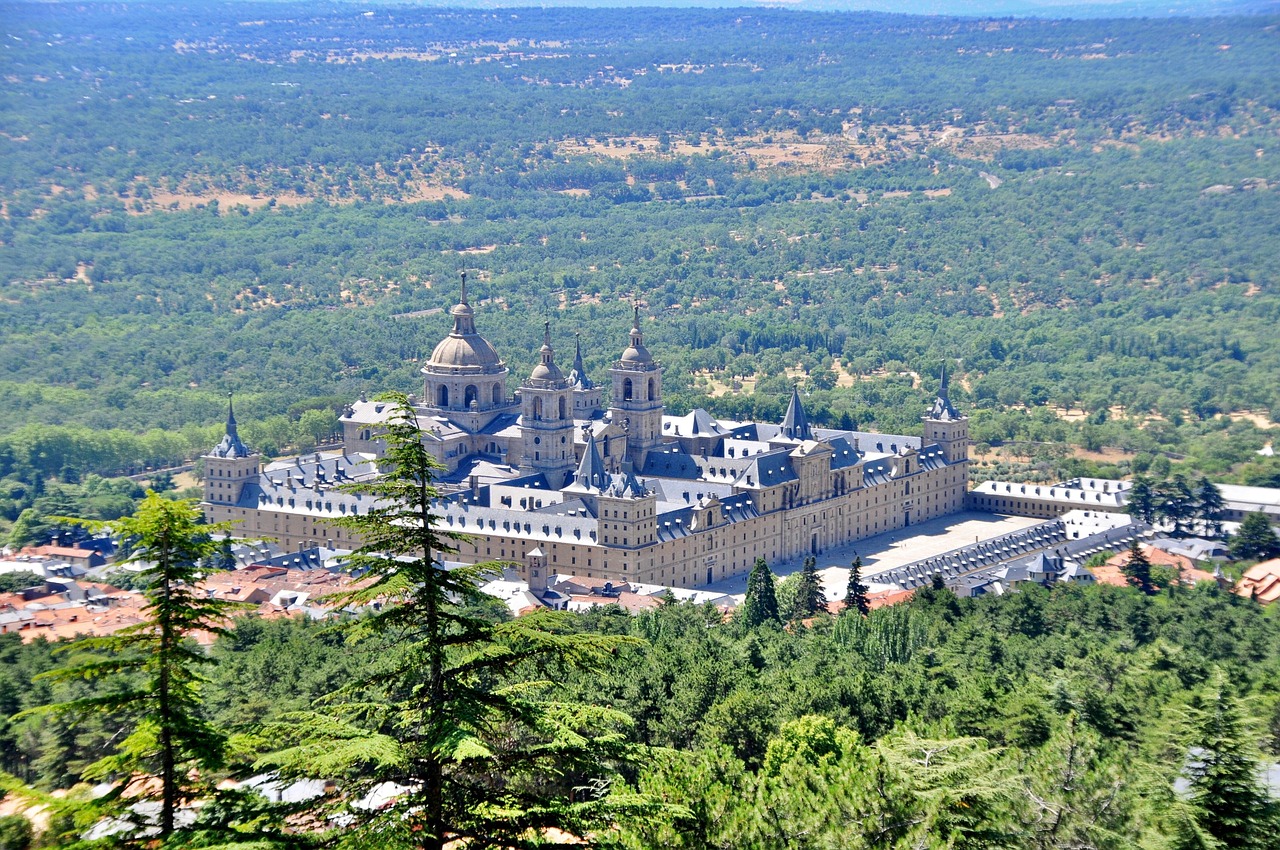
Philip II’s monastery-palace is the most ambitious Renaissance project ever undertaken in Spain—and one of the largest in Europe.
Built between 1563 and 1584, El Escorial combined a monastery, royal palace, library, church, and mausoleum in a single colossal complex.
The austere style deliberately rejected the ornamentation of earlier Spanish architecture, projecting Counter-Reformation severity.
The library contains over 40,000 volumes and manuscripts, with frescoed ceilings depicting the arts and sciences.
The royal pantheon houses most Spanish monarchs since Charles V, their marble tombs arranged in precise geometric order.
The architect Juan Bautista de Toledo, who trained in Italy, brought direct Italian influence to this most Spanish of projects.
UNESCO designated El Escorial as a World Heritage Site, and it remains essential for understanding Spanish Renaissance ambition.
4. Salamanca, Castile and León
The university city’s Renaissance heritage begins with Plateresque style—named for its resemblance to silversmith work.
The University of Salamanca’s facade is the supreme example, its intricate carved decoration covering every inch of surface.
Hidden somewhere in the carving is a small frog—finding it supposedly brings good luck to students facing exams.
The Convento de San Esteban features a stunning Plateresque facade that transitions into Churrigueresque Baroque inside.
The Casa de las Conchas (House of Shells) decorates its exterior with over 350 carved scallop shells, a Plateresque tour de force.
The New Cathedral, begun in 1513, shows how Gothic and Renaissance styles blended in this period of transition.
Salamanca’s golden sandstone gives all these buildings a warm unity that makes walking the city a continuous Renaissance experience.
5. Granada, Andalusia
Beyond the Alhambra, Granada has exceptional Renaissance monuments commissioned by Charles V to stamp Christian authority on the conquered Moorish capital.
The Palace of Charles V, a massive circular courtyard inserted into the Alhambra complex, is pure Italian Renaissance transplanted to Andalusia.
The Granada Cathedral, begun in 1518, was designed to be the first Renaissance church in Spain—a statement of the new order.
The Royal Chapel, attached to the cathedral, houses the tombs of Ferdinand and Isabella in a space bridging Gothic and Renaissance.
The Hospital Real, now part of the university, shows how Renaissance ideals extended to civic buildings.
Diego de Siloé, one of Spain’s greatest Renaissance architects, worked extensively in Granada before influencing Úbeda and Baeza.
The contrast between Moorish Alhambra and Christian Renaissance creates one of Spain’s most fascinating architectural dialogues.
6. Jaén, Andalusia
The Cathedral of Jaén is considered the masterpiece of Andrés de Vandelvira, the architect whose work shaped Renaissance Andalusia.
The twin towers and balcony-style facade influenced cathedral design throughout Latin America during the colonial period.
The building took nearly 200 years to complete, but maintains remarkable stylistic unity thanks to adherence to Vandelvira’s original vision.
Inside, the scale and classical proportions create spaces that feel more Roman than Spanish.
The cathedral’s claim to housing the relic of the Veil of Veronica makes it an important pilgrimage site.
Jaén is often overlooked between Granada and Córdoba, but the cathedral alone justifies a detour.
Combined with nearby Úbeda and Baeza, Jaén anchors a triangle of Renaissance excellence unmatched elsewhere in Spain.
7. Burgos, Castile and León
While famous for its Gothic cathedral, Burgos contains significant Renaissance additions that show how styles evolved and blended.
The Golden Staircase (Escalera Dorada) by Diego de Siloé is a Renaissance masterpiece inserted into the Gothic cathedral.
This double staircase influenced architects across Europe—including, reportedly, the designer of the Paris Opera.
The Chapel of the Constable, though technically late Gothic, incorporates Renaissance decorative elements.
The Casa del Cordón, a noble palace with a distinctive rope-carved facade, shows the Plateresque style in secular architecture.
The Arco de Santa María, the ceremonial entrance to the old city, was given a Renaissance facade in the 16th century.
Burgos demonstrates how Spanish Renaissance emerged not in isolation but in dialogue with the Gothic tradition.
8. Seville, Andalusia
The Archivo de Indias, built in the 16th century as the Merchants’ Exchange, now houses the historical archive of Spain’s American empire.
The building’s classical facade, attributed to Juan de Herrera (architect of El Escorial), brought Renaissance austerity to Seville.
The Casa de Pilatos claims to be modeled on Pontius Pilate’s house in Jerusalem, combining Italian Renaissance with Mudéjar elements.
The City Hall (Ayuntamiento) features Plateresque decoration that rivals anything in Salamanca.
UNESCO designated the Archivo de Indias, alongside the cathedral and Alcázar, as part of Seville’s World Heritage site.
The wealth that funded Seville’s Renaissance came directly from the Americas—this was the port through which gold and silver flowed.
Seville shows how Renaissance style could adapt to Andalusian climate and traditions without losing its classical roots.
9. Valladolid, Castile and León
Before Madrid became the capital, Valladolid was Spain’s most important city—and Renaissance architecture reflected that status.
The Church of San Pablo features a Plateresque facade of almost overwhelming intricacy, one of the finest in Spain.
The Colegio de San Gregorio, now the National Museum of Sculpture, has another extraordinary Plateresque facade.
Inside, the museum contains Spain’s greatest collection of polychrome wood sculpture, much of it from the Renaissance period.
The unfinished Cathedral, designed by Juan de Herrera, would have been the largest in Spain had it been completed.
The Royal Palace, where Philip II was born, shows the Renaissance style adapted for royal residence.
Valladolid is often skipped by tourists rushing to Salamanca, but its Renaissance heritage deserves equivalent attention.
10. Toledo, Castile-La Mancha
The former capital of Spain contains Renaissance monuments amid its more famous medieval and Moorish heritage.
The Alcázar, reconstructed multiple times, reached its Renaissance form under Charles V, who made it a royal residence.
The Hospital de Tavera, built as a charitable institution, is one of the finest Renaissance buildings in central Spain.
El Greco, though technically a Mannerist painter, worked in Toledo during the Renaissance period, and his museum occupies a Renaissance house.
The Church of San Juan de los Reyes, though begun in Gothic style, incorporates Renaissance elements in its decoration.
Toledo’s Renaissance heritage is often overlooked amid the focus on the “City of Three Cultures,” but rewards attention.
The contrast between Moorish, Gothic, and Renaissance creates a uniquely Toledan architectural dialogue.