Spain’s Most Striking Art Nouveau Buildings Hiding in Plain Sight
Everyone knows Gaudí.
The Sagrada Família draws millions. Casa Batlló is on every Barcelona postcard. Park Güell has become almost impossible to visit without advance booking.
But here’s what most tourists miss: Barcelona has literally hundreds of stunning Art Nouveau buildings that almost nobody photographs.
And the movement — called Modernisme in Catalan — spread far beyond one city and one architect.
Here’s where to find the Art Nouveau masterpieces that are hiding in plain sight.
Hospital de Sant Pau, Barcelona
This might be the most underrated UNESCO World Heritage Site in Spain.
Designed by Lluís Domènech i Montaner (who deserves as much credit as Gaudí for Modernisme), the hospital is a complex of 27 pavilions connected by underground tunnels.
Every building explodes with color — red brick, ceramic tiles, stained glass, and mosaic work covering every surface.
The Administration Building alone rivals anything Gaudí ever built, with soaring vaulted ceilings, intricate columns, and windows that filter rainbow light across marble floors.
It operated as a working hospital until 2009 and now functions as a museum and cultural center.
The crowds here are a fraction of what you’ll find at Sagrada Família or Park Güell.
You can actually take your time, explore at your own pace, and fully appreciate the craftsmanship.
Palau de la Música Catalana, Barcelona
The only concert hall in the world that’s a UNESCO World Heritage Site.
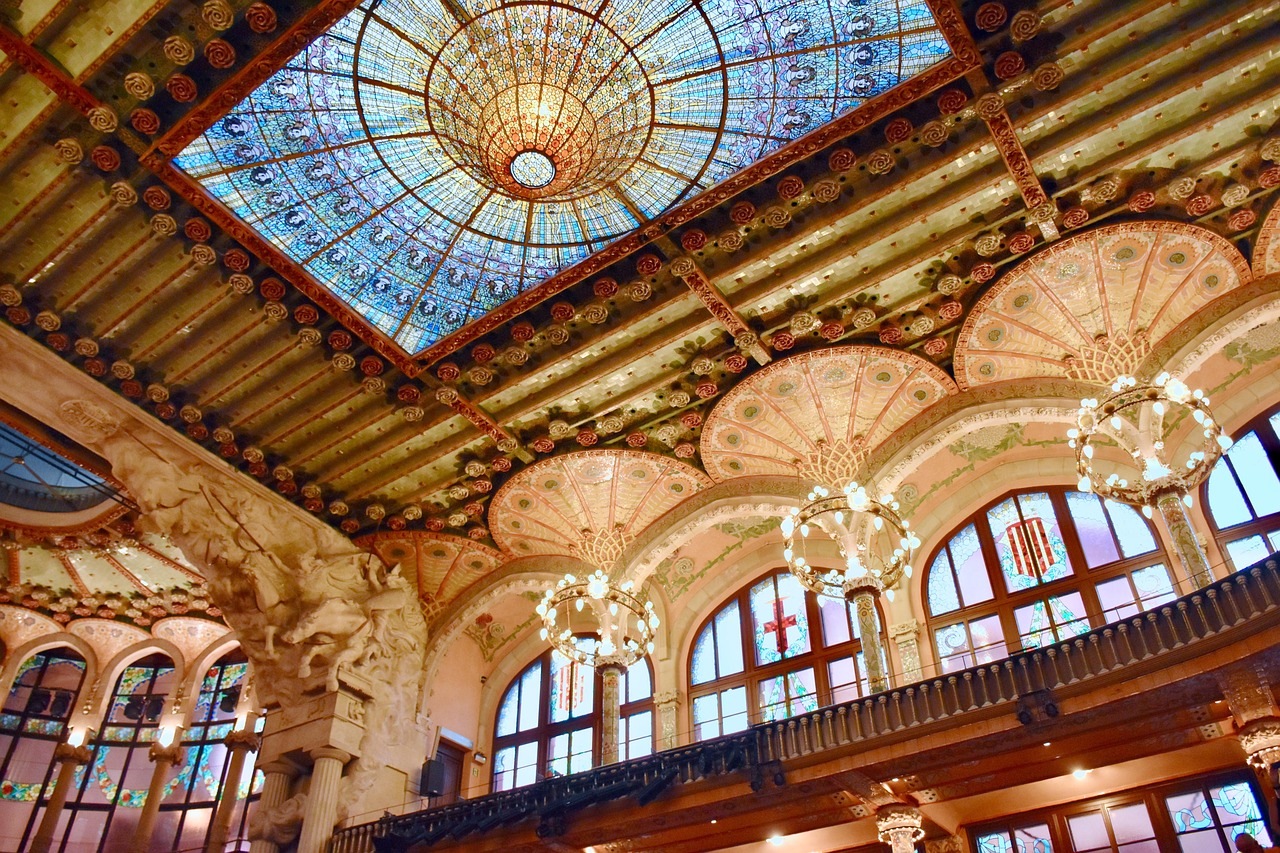
Also designed by Domènech i Montaner, the Palau is Modernisme at its most exuberant.
The exterior features ceramic roses, mosaics depicting Catalan musical history, and busts of famous composers.
Inside, the concert hall is a sensory explosion — an inverted stained glass dome, sculptures of Pegasus bursting from the ceiling, and ornamental columns that seem to dance.
Even the café and ticket areas are worth photographing.
Book a guided tour or attend a concert for full access.
The acoustics match the visuals — this is one of the best places in Europe to hear live classical music.
Casa de les Punxes, Barcelona
The “House of Points” or “House of Spires” looks like a German fairy-tale castle dropped into Barcelona.
Designed by Josep Puig i Cadafalch in 1905, it features six neo-Gothic towers topped with conical spires.
The building combines medieval references with Modernista flourishes — floral decorations, ceramic details, and organic ironwork.
It actually consists of three separate houses (one for each of his client’s sisters) that appear as a single unified block from the street.
The building is now used for offices with co-working spaces, so you might not be able to tour the interior.
But the exterior alone makes a detour worthwhile.
Casa Vicens, Barcelona
This was Gaudí’s first major commission — and most tourists have never heard of it.
Built between 1883 and 1885, it shows Gaudí before he developed his signature organic style.
Instead, the building features clear Arabic influences from the Mudéjar style, with geometric patterns, colorful ceramic tiles, and a fortress-like tower.
The green and white checkered tiles, combined with iron balconies shaped like palm leaves, create something utterly unique.
It opened to the public in 2017 after extensive restoration.
Located in the Gràcia neighborhood, it’s far from the Passeig de Gràcia crowds.
Consider it essential viewing for understanding how Gaudí evolved into the architect the world knows today.
The Eixample’s Secret Modernisme
Barcelona’s Eixample district was built as a planned expansion in the late 19th century, and wealthy residents competed to hire the best Modernista architects.
The result: hundreds of stunning buildings that tourists walk right past on their way to the famous ones.
The Block of Discord (Illa de la Discòrdia) puts four different architects’ works side by side — Casa Batlló (Gaudí), Casa Amatller (Puig i Cadafalch), Casa Lleó Morera (Domènech i Montaner), and Casa Mulleras (Enric Sagnier).
But wander any side street and you’ll find gorgeous apartment buildings with curved ironwork balconies, ceramic decorations, and organic stone carvings.
The doorways alone are worth a photography expedition.
These weren’t mansions for millionaires — they were everyday apartment buildings designed with extraordinary care.
Torre Bellesguard, Barcelona
One of Gaudí’s most overlooked works sits on the hillside below Tibidabo.
Built between 1900 and 1909, it combines Modernista elements with medieval Gothic — Gaudí’s personal interpretation of neo-Gothic architecture.
The site was once the residence of the last count of Barcelona, and Gaudí intentionally honored that history.
The result looks like a medieval castle filtered through Gaudí’s unique vision.
Far fewer visitors come here than to his more famous works, making it possible to actually appreciate the building without fighting crowds.
The surrounding grounds offer beautiful views over Barcelona.
CaixaForum, Barcelona
This former textile factory was designed by Puig i Cadafalch and is one of the most important industrial buildings of the Modernisme movement.
The red brick facade features neo-Gothic towers and Islamic-inspired crenellations.
It’s now a cultural center and museum, so you can explore both the architecture and the rotating exhibitions inside.
The building sits at the foot of Montjuïc, making it easy to combine with a visit to the Magic Fountain or the nearby museums.
Modernisme Beyond Barcelona
The movement wasn’t limited to one city.
Valencia’s Estación del Norte (North Station) features stunning Art Nouveau tilework throughout its halls — ceramics depicting oranges, traditional costumes, and Valencian landscapes.
Comillas in Cantabria has El Capricho, one of Gaudí’s earliest works — a whimsical building covered in ceramic sunflowers that few tourists ever visit.
Reus (Gaudí’s birthplace) has the Ruta del Modernisme, a walking tour past dozens of Art Nouveau buildings.
Even small towns sometimes hide Modernista gems — pharmacies, houses, and public buildings designed during the movement’s peak.
Why Modernisme Matters
Art Nouveau was a reaction against industrialization.
While factories churned out identical products, Modernista architects insisted on handcrafted details, organic forms, and beauty in everyday life.
In Catalonia, the movement also expressed growing national consciousness — a desire to create something distinctly Catalan during a period of cultural renaissance.
The result was architecture that celebrates craftsmanship, nature, and regional identity.
It’s architecture that makes you feel something.
No other city on earth has as much Art Nouveau architecture as Barcelona.
But most visitors see only a tiny fraction of it.
The buildings hiding in plain sight — the apartment blocks, hospitals, concert halls, and factories — tell the full story of a movement that transformed a city.
And they’re waiting for you to discover them.