Skip the Tourist Beaches: 7 Strange Spanish Shores Worth Finding
You’ve seen white-sand beaches.
You’ve seen black-sand beaches.
Maybe even the occasional pebble beach.
But have you ever stepped onto a shore that looks like it’s made of popcorn?
Or walked through stone arches that vanish under the tide?
Spain’s coastline is full of surprises — bizarre, breathtaking, and sometimes hard to believe.
These seven beaches prove that the country’s most magical spots aren’t always the ones with beach clubs and sun loungers.
Quick Picks: Find Your Kind of Weird
🍿 For pure strangeness: Popcorn Beach — fossilized coral that looks exactly like movie snacks
⛪ For natural architecture: Playa de las Catedrales — cathedral-sized stone arches carved by the sea
🌊 For the impossible: Playa de Gulpiyuri — an inland beach with no ocean in sight
🏜️ For dramatic isolation: Playa de Cofete — 12 kilometers of wild, windswept solitude
🏛️ For history + beach combo: Playa de Bolonia — Roman ruins meet turquoise water
🌅 For raw beauty: La Pared — cliffs, surf, and sunsets that set the horizon on fire
1. Popcorn Beach, Fuerteventura

Let’s start with the weirdest one.
Playa del Bajo de la Burra, nicknamed “Popcorn Beach,” looks like someone spilled an entire tub of movie popcorn on the shore and never cleaned it up.
Those “kernels” are actually pieces of fossilized red algae known as rhodoliths, bleached white by the sun and sea.
The effect is mesmerizing — millions of tiny coral-like bits crunching under your feet, all set against turquoise water.
How to get there: It’s about a 15-minute drive north of Corralejo. The last stretch is on a dirt road, but any car can handle it with care.
What to know: Don’t take any “popcorn” home — it’s illegal to remove them. Wear sturdy sandals; it’s not comfortable barefoot.
When to go: Early morning for soft light and fewer people.
For more Fuerteventura weirdness, this island also has some of Spain’s most epic places.
2. La Pared, Fuerteventura

Over on the island’s wild west coast, La Pared feels like the end of the world.
Towering cliffs, roaring waves, and a dramatic sunset that seems to set the whole horizon on fire.
It’s not a swimming beach — the surf here is strong — but it’s a favorite for surfers, photographers, and anyone craving solitude.
You’ll often have huge stretches of sand all to yourself.
How to get there: About 1.5 hours from Corralejo or 30 minutes from Costa Calma by car. There’s a small parking area above the cliffs.
What to know: Bring layers — the wind can get fierce, even on sunny days.
Best for: Sunset photography, quiet walks, and wild, untouched nature.
3. Playa de las Catedrales, Galicia

In northern Spain, the sea has carved massive stone arches into the cliffs near Ribadeo — so huge they look like gothic cathedrals.
At low tide, you can walk between the arches and through sea caves that disappear completely once the tide rolls in.
The formations are otherworldly, especially when waves crash against the rock walls and light filters through the gaps.
How to get there: Near Ribadeo in Galicia, about a 10-minute drive from the town center.
What to know: From July to September, you need a free online permit to access the beach during low tide. Check the tide schedule before you go — at high tide, it’s completely covered.
Best for: Photographers, geology lovers, and anyone who likes a bit of mystery.
This beach is near the Camino del Norte route — if you’re walking, check out our Camino de Santiago beginner’s guide.
Book Playa de las Catedrales permits →
4. Playa de Gulpiyuri, Asturias

Imagine standing on soft sand, surrounded by rolling green fields, with no ocean in sight — yet hearing waves.
That’s Gulpiyuri, a tiny inland beach connected to the sea through underground tunnels.
When the tide is high, seawater flows in to fill the shallow cove.
When it’s low, the water disappears, leaving behind soft sand and rock pools.
It’s like a miniature beach that breathes with the ocean.
How to get there: Near Llanes, Asturias. From the N-634 road, there’s a small parking area followed by a 10-minute walk through fields.
What to know: Visit at mid-to-high tide for the full “beach” experience. Bring water shoes if you want to wade in — the seabed is rocky.
Best for: Families, nature photographers, and curious travelers.
We wrote an entire post about the strange beauty of Playa de Gulpiyuri — it’s worth the deep dive.
5. Cala de Enmedio, Almería

Tucked deep inside Cabo de Gata Natural Park, Cala de Enmedio feels completely untouched.
Smooth white cliffs — eroded into soft, wavy shapes — frame a quiet cove of clear blue water.
It’s one of those rare beaches where you can still hear nothing but the sea and the wind.
The walk to get there adds to the magic: a 30-minute coastal hike through desert-like hills.
How to get there: From Agua Amarga, follow the coastal path on foot or go by kayak. There’s no road access.
What to know: No facilities, no shade, no crowds — bring everything you need.
Best for: Adventure seekers, couples, and photographers.
Cabo de Gata is one of Spain’s most underrated places — the entire park is stunning.
6. Playa de Cofete, Fuerteventura
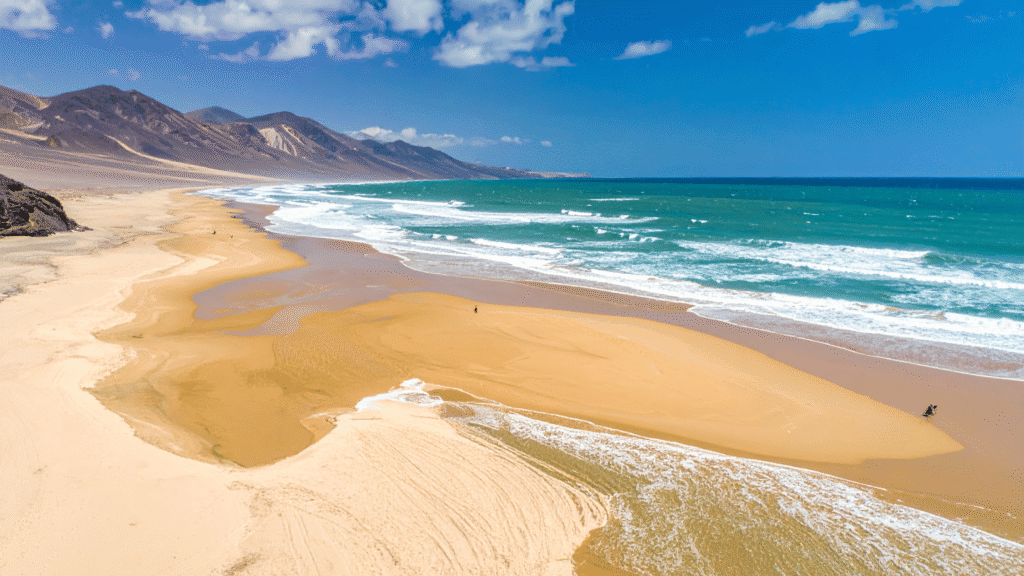
Cofete is less of a beach and more of a mood.
It stretches for nearly 12 kilometers, framed by the misty Jandía mountains.
The waves crash relentlessly, the sand feels endless, and the sense of isolation is absolute.
Getting there isn’t easy — a rough dirt road snakes through the mountains — but the journey is half the adventure.
When you finally arrive, you’ll understand why locals call it one of the island’s sacred places.
How to get there: About 45 minutes by car from Morro Jable. A 4×4 is recommended, though small cars can make it if you drive slowly.
What to know: Strong currents make it unsafe for swimming. Bring water, food, and a sense of awe.
Best for: Day trips, epic photography, and wild landscapes.
7. Playa de Bolonia, Cádiz

A beach where ancient history meets natural beauty.
Playa de Bolonia is home to the Roman ruins of Baelo Claudia, where you can wander through stone columns before dipping into turquoise water.
Just next to the ruins sits the famous Bolonia dune — a giant, windswept sandhill you can climb for sweeping views of the Strait of Gibraltar.
It’s a one-stop destination for history buffs and beach lovers alike.
How to get there: About 25 minutes from Tarifa by car. There’s parking by the dunes and the ruins.
What to know: The climb up the dune is steep but short. Bring shoes and water.
Best for: History lovers, families, and anyone who wants a “wow” beach day without hiking for miles.
The ruins here are featured in our guide to Spain’s most spectacular Roman ruins — don’t miss them.
Plan Your Weird Beach Adventure
Ready to see Spain’s strangest shores?
Getting Around
Most of these beaches require a car — especially on Fuerteventura.
For mainland destinations like Galicia and Asturias:
Travel Insurance
Remote beaches, rough roads, and rocky shores — better to be covered.
Keep Exploring Spain’s Wild Coast
Loved these weird beaches?
Here’s more Spanish coastline you won’t believe:
- Spain’s Most Secret Beaches — Hidden sand without the crowds
- 10 Epic Places in Spain That Look Too Wild to Be Real — More “is this real life?” moments
- Spain’s Most Jaw-Dropping Canyons — Dramatic landscapes inland
- The Pink Lake in Spain — Another natural wonder
- Spain’s Unreal Beaches — More jaw-dropping coastline
The Bottom Line
Spain’s best beaches aren’t always the famous ones.
Sometimes they’re covered in fossilized popcorn.
Sometimes they’re hidden inland, breathing with underground tunnels.
Sometimes they come with 2,000-year-old Roman ruins as a backdrop.
These are the beaches that remind you why travel still has the power to surprise you.
So skip the crowded resort.
Rent a car.
Find something strange.
Spain’s weirdest shores are waiting.
Which of these beaches blew your mind?
Or have you found an even stranger Spanish shore?
Tell us in the comments — we’re always hunting for the next “is this real?” beach.
Related Posts You’ll Love:
- Spain’s Most Secret Beaches
- 10 Epic Places in Spain That Look Too Wild to Be Real
- The Pink Lake in Spain
Bookmark this post — your weird beach adventure starts here.