Spain’s Most Mind-Blowing UNESCO World Heritage Sites You Can’t Miss
Spain has 49 UNESCO World Heritage Sites—the third most of any country on Earth, behind only Italy and China.
Which means you could spend years exploring places that the international community has literally voted “of outstanding universal value to humanity.”
We’re talking about Roman aqueducts that still stand after 2,000 years, Moorish palaces so intricate they make you question what humans are capable of, and cave paintings that prove our ancestors were artists before they were farmers.
Some of these sites are obvious bucket-list destinations that don’t need introduction.
Others are hidden in provincial towns that rarely appear in guidebooks, waiting for travelers curious enough to seek them out.
All of them earned their UNESCO status by being genuinely exceptional—and all of them will leave you understanding why preserving our collective heritage matters.
Here are the ones that will absolutely blow your mind.
1. The Alhambra, Generalife and Albaicín, Granada – The Moorish Masterpiece
If you only visit one UNESCO site in Spain, make it this one—and book your tickets months in advance because everyone else had the same idea.
The Alhambra is simply one of the most extraordinary buildings ever constructed, a 14th-century Nasrid palace complex that represents the pinnacle of Islamic art and architecture in Europe.
The Nasrid Palaces are almost impossibly intricate, with carved stucco walls, geometric tile work, and courtyards designed to make light and water perform architectural magic.
The Generalife gardens above offer the tranquil counterpoint—flowing fountains, cypress-lined pathways, and views across to the snow-capped Sierra Nevada.
Below the palace, the Albaicín preserves the medieval Moorish quarter with its narrow cobblestone streets and traditional carmenes (whitewashed houses with walled gardens).
UNESCO inscribed the Alhambra and Generalife in 1984 and added the Albaicín in 1994, recognizing that this entire complex represents something irreplaceable in human cultural history.
The famous Mirador de San Nicolás viewpoint in the Albaicín offers the most iconic Alhambra photograph at sunset—prepare for crowds and guitarists providing the soundtrack.
2. Works of Antoni Gaudí, Barcelona – Seven Buildings, One Genius
Seven of Gaudí’s Barcelona buildings share a collective UNESCO designation, and honestly, each one could justify its own listing.
The Sagrada Família—still under construction 143 years after Gaudí began it—defies every architectural convention with its organic forms, colored light, and absolutely bonkers ambition.
Park Güell transforms a hillside into a mosaic-encrusted wonderland of public space, while Casa Batlló and Casa Milà (La Pedrera) turn apartment buildings into sculptural fever dreams.
The Palau Güell, Gaudí’s first major commission for his patron, demonstrates the architect’s genius even in his thirties.
The crypt at Colònia Güell, though unfinished, is considered Gaudí’s most structurally innovative work—the ceiling seems to defy gravity in ways that still confuse engineers.
Casa Vicens, Gaudí’s first residential project, opened to the public only in 2017 and remains the least crowded of his UNESCO sites.
Together, these buildings demonstrate an artistic vision so singular that UNESCO recognized them as contributing “outstanding universal value” to the history of architecture.
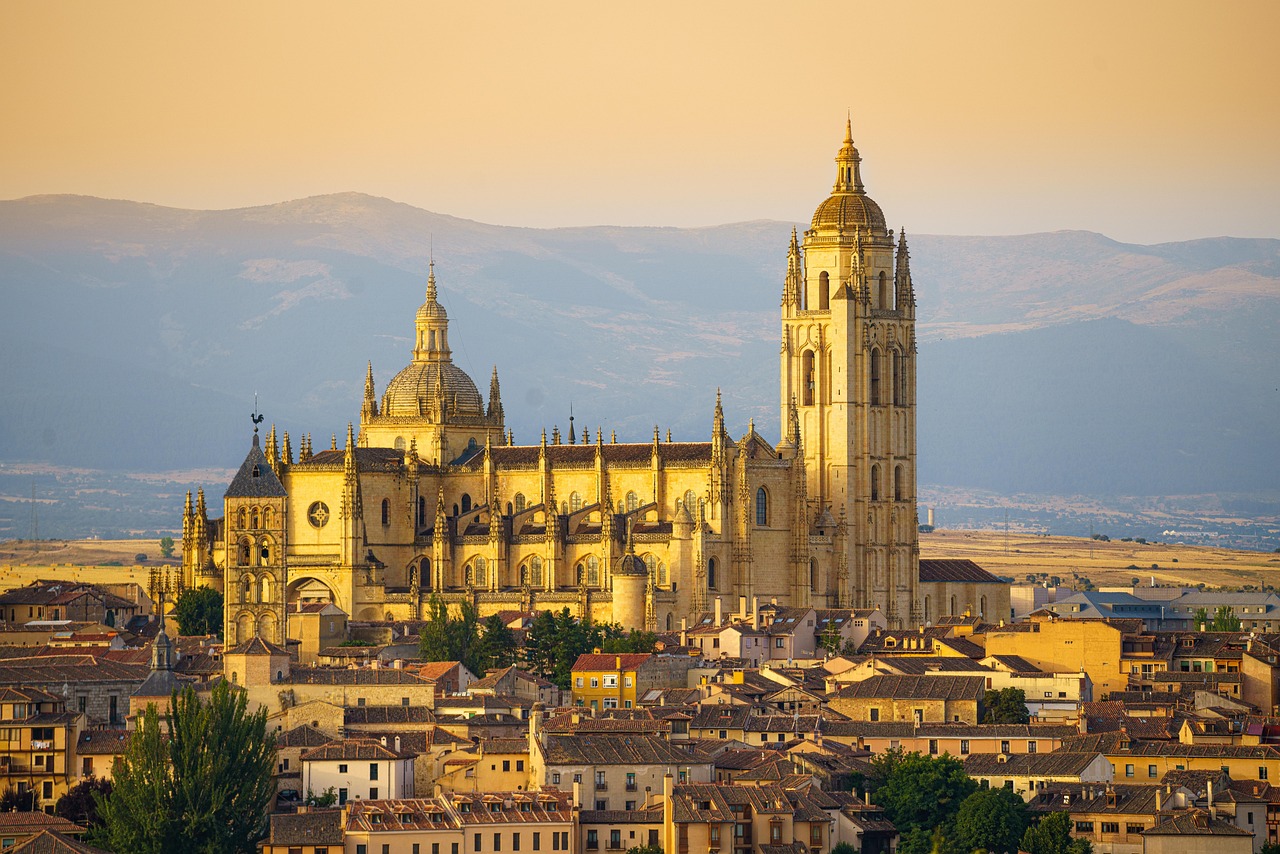
3. Old Town of Segovia and Its Aqueduct – Roman Engineering Perfection
The Aqueduct of Segovia might be the single most impressive Roman structure still standing anywhere in the world—and it kept working until 1973.
Built around the turn of the 1st century AD, this massive construction features 167 arches stretching 813 meters and reaching heights of 28.5 meters above Plaza del Azoguejo.
Here’s what makes engineers lose their minds: the approximately 20,400 granite blocks were assembled without any mortar or cement, held together only by perfect cutting and the force of gravity.
Beyond the aqueduct, Segovia’s old town justifies its UNESCO status with the fairytale Alcázar (said to have inspired Disney’s Cinderella castle) and a Gothic cathedral so massive it’s visible from miles away.
The city makes an easy day trip from Madrid, but staying overnight lets you see the aqueduct dramatically illuminated after the tour buses leave.
Stand beneath those towering arches at sunset and try to comprehend that Romans built this nearly 2,000 years ago, and it’s still standing perfectly level.
4. Archaeological Ensemble of Mérida – Rome’s Spanish Capital
If you’re serious about Roman history, Mérida in Extremadura is arguably more impressive than anything in Spain—and far less crowded than the Italian alternatives.
Founded in 25 BC as Emerita Augusta, this was the capital of the Roman province of Lusitania and once one of the most important cities in the entire empire.
The Roman Theatre, with its original two-story scaenae frons still largely intact, still hosts performances every summer in the same space where audiences sat two millennia ago.
The amphitheater next door held 15,000 spectators for gladiator fights, while the world’s longest surviving Roman bridge still spans the Guadiana River at 792 meters.
But what makes Mérida exceptional is the sheer concentration of remains: aqueducts (two of them), circus, temple of Diana, triumphal arches, houses with preserved mosaics, an early Christian basilica.
You can spend days here wandering between ruins that would be headlining attractions anywhere else but in Mérida are almost overwhelmingly abundant.
UNESCO inscribed the ensemble in 1993, recognizing it as one of the best-preserved examples of a Roman provincial capital.
5. Historic City of Toledo – The City of Three Cultures
Before Madrid became Spain’s capital, there was Toledo—a walled city on a hill above the Tagus River where Christians, Muslims, and Jews lived together during the medieval golden age.
That coexistence left an architectural legacy that’s genuinely unique: Romanesque, Gothic, and Mudéjar churches; synagogues that survived the expulsion; mosques converted to Christian use but retaining Islamic craftsmanship.
The Cathedral of Toledo alone could occupy hours, with its treasury, sacristy, and El Greco paintings requiring careful attention.
The Alcázar fortress dominates the skyline and houses a military museum with perspectives on Spanish history that European visitors might find illuminating.
But Toledo’s real magic is in wandering—losing yourself in narrow medieval streets, discovering hidden courtyards, and gradually understanding how different religious traditions wove together in this remarkable place.
The famous El Greco house and museum adds artistic depth, while the sunset views from across the river at the Mirador del Valle are absolutely iconic.
6. Old City of Salamanca – The Golden City
Salamanca’s old town glows golden at sunset, earning it the nickname “La Dorada”—and that warm sandstone light reflects centuries of architectural and intellectual achievement.
The University of Salamanca, founded in 1218, is one of the oldest in Europe, and its Plateresque façade is so detailed you could study it for hours (and generations of students have, looking for the famous carved frog that supposedly brings exam luck).
The Plaza Mayor is widely considered Spain’s most beautiful public square, a Baroque masterpiece by architect Alberto Churriguera with 88 arches and more than 400 balconies.
Two cathedrals sit side by side—the Romanesque Old Cathedral and the Gothic-Baroque New Cathedral—with the older one accessible only through the newer, creating an architectural timeline spanning 600 years.
Salamanca remains a university town, meaning the terraces around Plaza Mayor fill with students at night, keeping the medieval streets alive with youthful energy.
UNESCO inscribed the Old City in 1988, and the designation feels almost understated given how much architectural treasure is concentrated here.
7. Old Town of Cáceres – Medieval Time Capsule
If Toledo feels too polished and touristy, Cáceres offers the alternative: a medieval walled city that’s somehow escaped mass tourism despite being spectacularly preserved.
The monumental city within the walls is essentially a museum of medieval and Renaissance architecture, with noble palaces, defensive towers, and churches that haven’t been sanitized for visitors.
The Plaza Mayor sits just outside the walls, providing the transition between modern Cáceres and its time-capsule old town.
At night, when the walls are illuminated and the streets empty, walking through Cáceres feels genuinely like stepping back in time—which is exactly why HBO filmed Game of Thrones scenes here.
The old town is small enough to explore thoroughly in half a day, making Cáceres an excellent stop on routes between Madrid and Lisbon or on the way to Mérida.
UNESCO inscribed it in 1986, recognizing a blend of Roman, Islamic, Northern Gothic, and Italian Renaissance architecture that exists nowhere else in quite this concentration.
8. Monastery and Site of the Escurial, Madrid – The Royal Colossus
El Escorial isn’t subtle—this massive 16th-century complex northwest of Madrid was built to be the definitive statement of Spanish Habsburg power, and it absolutely overwhelms.
King Philip II commissioned it as a royal palace, monastery, basilica, library, and mausoleum, creating a building that covers 33,327 square meters and contains over 1,200 doors and 2,673 windows.
The library alone, with its frescoed ceilings and 40,000 rare volumes, is worth the trip from Madrid.
The Royal Pantheon houses the remains of nearly all Spanish monarchs since Charles I, their marble tombs stacked in a circular underground chamber that feels appropriately eternal.
The basilica’s main altarpiece is 30 meters tall, and the monastery’s collection includes works by El Greco, Titian, and Velázquez.
El Escorial is accessible by train from Madrid, making it one of the easiest UNESCO sites to visit on a day trip—though the sheer scale of the complex rewards longer exploration.
9. Cave of Altamira and Paleolithic Cave Art – The Sistine Chapel of Prehistory
The paintings in Altamira are somewhere between 15,000 and 35,000 years old, and they’re so sophisticated that when they were first discovered in 1879, experts refused to believe prehistoric humans could have created them.
Red bison cover the cave ceiling, rendered with such dynamism and naturalism that they challenge everything you think you know about ancient art.
Here’s the catch: you almost certainly won’t see the originals, because the cave is now closed to general public access to preserve the paintings from the damage that human breath and humidity cause.
However, the Museum of Altamira next door contains a full-scale replica called the Neocueva that reproduces every detail of the original cave—and it’s genuinely spectacular.
Each week, five visitors are randomly chosen from museum visitors to enter the actual cave, so there’s a lottery element to your visit.
UNESCO inscribed Altamira alongside other Paleolithic sites in northern Spain, recognizing the collection as evidence of human artistic achievement at the very dawn of culture.
10. Antequera Dolmens Site – Neolithic Monuments Meet Surreal Landscape
Here’s a UNESCO site that flies completely under the radar: the dolmens of Antequera, megalithic tombs from 5,000 years ago that are among the best-preserved in Europe.
The Menga Dolmen is the largest in Europe, its massive stone slabs creating a burial chamber that required astonishing organization to construct without modern technology.
The Viera and El Romeral dolmens complete the trio, each demonstrating different construction techniques and ceremonial purposes.
What makes Antequera’s UNESCO site special is the inclusion of two natural monuments: La Peña de los Enamorados (a rock formation resembling a sleeping face) and El Torcal (a surreal karst landscape that looks like another planet).
UNESCO recognized that the dolmens were intentionally aligned with these natural features, creating a sacred landscape that integrated human construction with geological wonder.
All five elements are free to visit, making Antequera one of Spain’s most accessible—and least crowded—UNESCO destinations.