Spain’s Most Mind-Blowing Traditional Festivals That’ll Change How You Party Forever
If there’s one thing Spain does better than almost anywhere else on Earth, it’s throwing a fiesta.
We’re not talking about nightclubs or beach parties—we’re talking about centuries-old celebrations where entire cities transform, where communities come together in traditions that predate tourism by hundreds of years, and where the line between participant and spectator essentially disappears.
The Spanish never do anything half-heartedly, and their festivals prove it: massive bonfires consuming towering sculptures, tomato fights that turn streets red, solemn religious processions that have occurred annually since medieval times, and bull runs that remain as controversial as they are famous.
These aren’t events created to attract tourists—they’re genuine expressions of regional identity that happen to welcome visitors who want to join in.
Time your visit right, and you won’t just see Spain—you’ll experience it in ways that no museum or monument can match.
1. Las Fallas – Valencia’s Festival of Fire
Every March, Valencia transforms into an open-air gallery of towering papier-mâché sculptures, then burns them all in massive bonfires that light up the night sky.
The Fallas (the sculptures themselves) are elaborate constructions mocking politicians, celebrities, and social issues, crafted by local artisans over months of painstaking work.
The festival officially begins with La Crida, a ceremonial call to celebration, building through days of parades, fireworks, and the Mascletà—daily gunpowder explosions in the Plaza del Ayuntamiento that you feel in your chest rather than just hear.
On March 17 and 18, the Ofrenda de Flores sees locals in traditional dress bringing elaborate flower arrangements to construct a floral tapestry honoring the Virgin Mary.
Then comes La Cremà on March 19, when all but one Falla (the winner, preserved in the Fallero Museum) spectacularly combusts while firefighters stand ready and crowds cheer into the night.
UNESCO has recognized Las Fallas as Intangible Cultural Heritage of Humanity—quite a distinction for a festival centered on burning things down.
2. Semana Santa – Holy Week in Seville
Holy Week is celebrated throughout Spain, but Seville’s Semana Santa is considered the most iconic, transforming the city into a procession of incense, candlelight, and centuries-old devotion.
From Palm Sunday through Easter, religious brotherhoods (hermandades) carry enormous floats depicting biblical scenes through the streets, some so heavy they require dozens of costaleros moving in synchronized steps beneath.
Hooded penitents called nazarenos march solemnly, some barefoot, carrying candles or crosses while brass bands play mournful music that echoes off narrow stone streets.
The atmosphere is genuinely moving regardless of religious belief—thick with incense, flickering candlelight, and a deep sense of tradition that connects modern Sevillanos to their medieval ancestors.
Night processions are particularly powerful, with floats emerging from churches lit only by candles, their golden decorations glinting in the darkness.
Arrive early for viewing spots, respect the solemn tone, and prepare for an experience that reveals Spain’s Catholic soul in ways that cathedrals alone cannot.
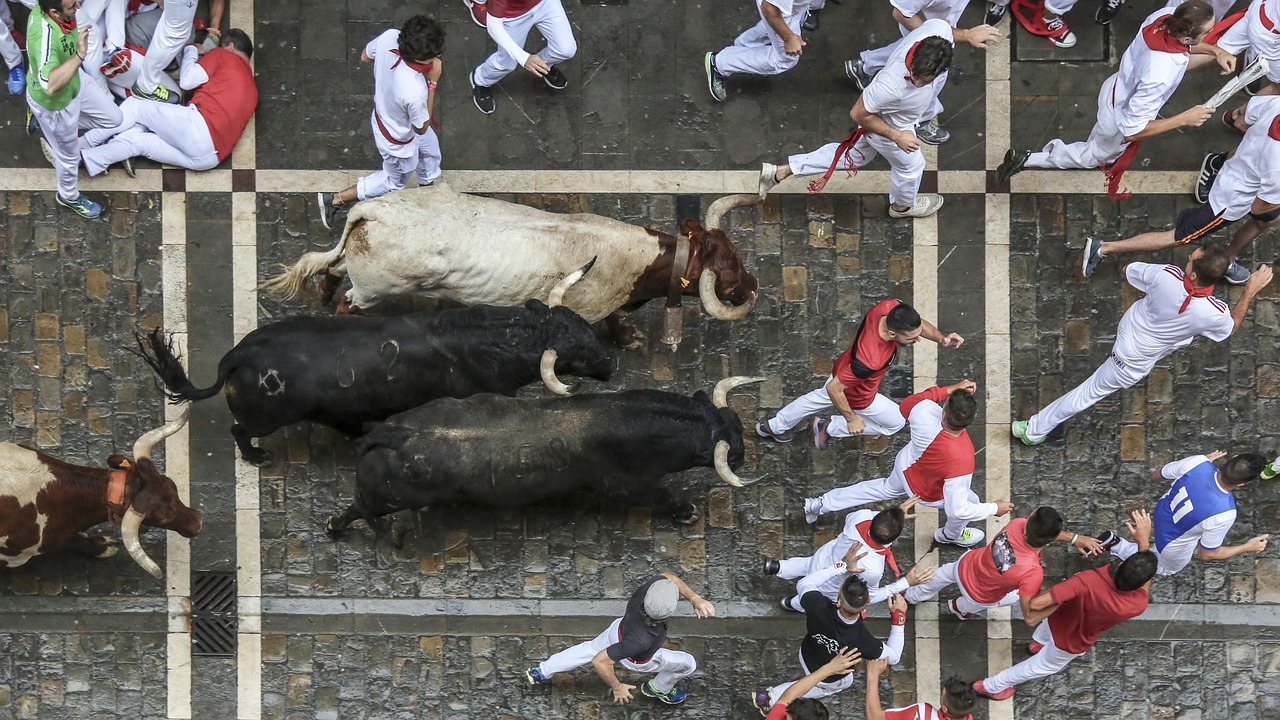
3. San Fermín – The Running of the Bulls in Pamplona
A rocket launch on July 6th marks the beginning of San Fermín, a nine-day festival that includes Spain’s most famous (and controversial) event: the Encierro, or Running of the Bulls.
Every morning at 8 AM, six bulls and six steers charge through Pamplona’s narrow streets while runners in white with red scarves attempt to stay just ahead of the horns.
Ernest Hemingway’s “The Sun Also Rises” brought international attention to the festival, and today over a million people attend what has become one of Europe’s largest street parties.
Beyond the bull runs, San Fermín includes processions, traditional dances, El Struendo (“The Roar”) when crowds make as much noise as possible for hours, and non-stop celebrations that continue around the clock.
The festival culminates with “Pobre de Mí” (“Poor Me”), a candlelit singing that marks the sad return to normal life.
Controversy over animal welfare has intensified in recent years, and many visitors choose to experience San Fermín’s other traditions without attending the bull runs themselves.
4. La Tomatina – The World’s Largest Food Fight
Every August, the usually sleepy town of Buñol near Valencia erupts into controlled chaos as 20,000 people pelt each other with overripe tomatoes for exactly one hour.
The tradition began accidentally in 1945, was banned in the 1950s, then reinstated in 1957 and has grown into a bucket-list experience for travelers worldwide.
Rules exist: tomatoes must be squashed before throwing to limit injuries, and the fight ends precisely when a second rocket signals time’s up.
The mess is absolutely unbelievable—streets run red with tomato juice, clothing is ruined beyond salvation, and participants emerge looking like they’ve bathed in gazpacho.
Fire trucks hose down the streets afterward, and the citric acid in the tomatoes actually leaves everything cleaner than before.
Tickets are now required and sell out quickly, so plan months ahead if you want to put a whole new meaning to “painting the town red.”
5. Feria de Abril – Seville’s April Fair
What began as a livestock fair in 1847 has evolved into Seville’s most glamorous celebration of Andalusian culture—a week of sherry, flamenco, horse-drawn carriages, and traditional dress.
The fairgrounds fill with casetas (tent pavilions), most privately owned by families, businesses, or associations, where Sevillanos in traditional trajes de flamenca and trajes cortos gather to dance sevillanas and drink rebujito (sherry with lemonade).
During the day, the Feria is a family affair with horse parades, carriage rides, and leisurely meals inside the casetas.
At night, it transforms into something more adult, with parties continuing until dawn and the sound of flamenco guitars drifting across the grounds.
Unlike most Spanish festivals, tourists can’t simply wander into private casetas—you need an invitation from a member—though the public Caseta Municipal welcomes everyone.
The Feria also marks the opening of Seville’s bullfighting season at La Real Maestranza, one of the most prestigious rings in Spain.
6. Carnival in Santa Cruz de Tenerife
The Canary Islands host the largest Carnival celebrations in Spain—and arguably the second largest in the world after Rio de Janeiro.
For two weeks every February, Santa Cruz de Tenerife transforms into an explosion of color, costumes, music, and dancing that continues well into the earliest morning hours.
The tradition arrived with conquistadors in the late 15th century, meaning Tenerife’s Carnival has roots stretching back over 500 years.
Key events include the crowning of the Carnival Queen, the Grand Parade with elaborate floats and costumed groups, and the Burial of the Sardine on Ash Wednesday—a mock funeral procession marking the end of revelry before Lent.
Streets fill with revelers in increasingly creative costumes, live music stages appear throughout the city, and normal life essentially suspends for the duration.
The combination of Canarian warmth (February temperatures hover around 20°C) and Caribbean-influenced celebration creates a unique atmosphere found nowhere else in Spain.
7. Las Hogueras de San Juan – Midsummer Bonfires
On June 23rd, the eve of Saint John’s Day, enormous bonfires appear on beaches throughout Mediterranean Spain—most spectacularly in Alicante, Valencia, and Barcelona.
The tradition of welcoming summer with fire stretches back to pre-Christian times, later absorbed into celebrations of Saint John the Baptist’s birthday.
In Alicante, the celebration resembles a smaller Las Fallas, with elaborate sculptures constructed in the streets before being burned in bonfires reaching several stories high.
Families and friends gather for dinner, then head to the beach as midnight approaches, setting off fireworks and leaping over small fires for good luck.
The following day is a regional holiday in many areas, allowing recovery from celebrations that typically continue until dawn.
Swimming at midnight is traditional—a ritualistic cleansing to prepare for the new season—though the Mediterranean in late June is warm enough to make this thoroughly pleasant rather than penitential.
8. Fiesta Mayor de Gràcia – Barcelona’s Neighborhood Showdown
Every August, the streets of Barcelona’s Gràcia neighborhood transform into an explosion of creativity as residents compete for the best decorated street.
Each block chooses a theme, then neighbors work together to create elaborate decorations—canopies, sculptures, lighting—that transform ordinary streets into immersive art installations.
The competition is fierce, standards are impossibly high, and the results turn an entire neighborhood into a walkable gallery.
The week-long celebration includes over 600 concerts, workshops, parades, and the famous castellers—human tower builders who assemble themselves into structures eight levels high before (hopefully) controlled collapse.
Unlike many Spanish festivals with religious origins, Gràcia’s Festa Major emphasizes community creativity and neighborhood pride.
Long tables appear in the streets for communal meals, and the atmosphere is welcoming to visitors who want to wander, admire, and join the celebration.
9. El Rocío – The Great Pilgrimage
Each May, up to a million pilgrims converge on the village of El Rocío on the edge of Doñana National Park for Spain’s most spectacular religious pilgrimage.
The Romería del Rocío sees brotherhoods from across Andalusia making the journey to venerate the Virgen del Rocío, many traveling on horseback, in decorated wagons, or on foot through the marshlands.
The pilgrimage itself is as important as the destination—days of traveling together, camping along the route, singing traditional songs, and forging bonds that connect communities.
The village swells from a normal population of a few hundred to something resembling a tent city, with flamenco performances, horseback displays, and religious devotion mixing in uniquely Andalusian fashion.
The climax comes in the early hours of Monday morning when the Virgin’s image is carried through crowds of devoted followers who consider it an honor to touch the float.
El Rocío represents Spain’s Catholic traditions at their most fervent and communal—intense, emotional, and utterly unlike anything in northern Europe.
10. San Sebastián’s Tamborrada – The City That Drummed All Night
Every January 20th, San Sebastián becomes the loudest city in Spain as thousands of drummers parade through the streets for 24 consecutive hours.
The Tamborrada begins at midnight in the Plaza de la Constitución, when the mayor raises the city’s flag and the first drums begin—continuing without pause until midnight the following day.
Over 100 drumming societies participate, their members dressed as cooks and soldiers (commemorating local traditions), filling every street with rhythmic thunder.
Children have their own tamborrada, parading through the streets during daytime hours while adults take the night shifts.
The sound is genuinely overwhelming—an experience you feel in your bones rather than simply hear—and sleep is essentially impossible anywhere near the old town.
Street parties, food, and drink accompany the drumming, ensuring that anyone who can’t sleep (which is everyone) has plenty of entertainment until the final beat at midnight.