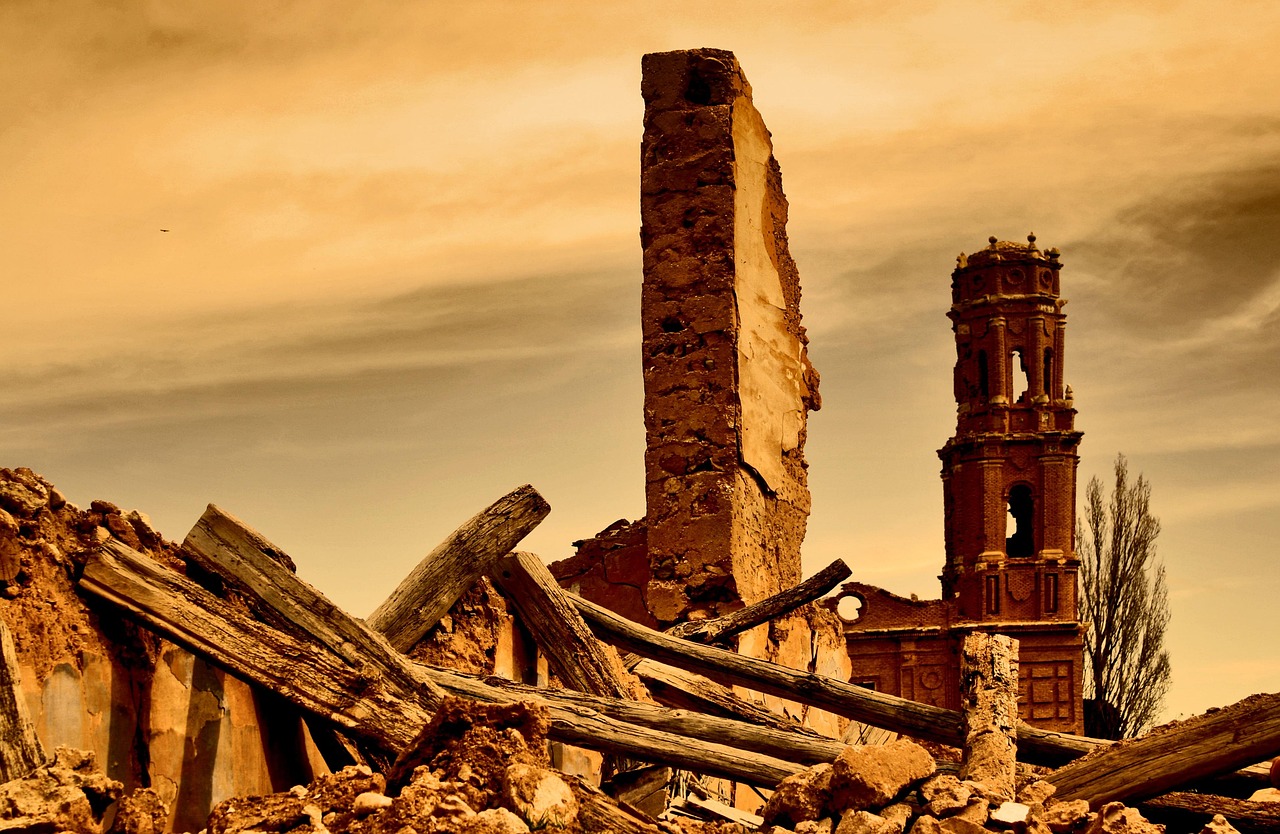
Spain’s Most Hauntingly Beautiful Abandoned Places You Can Still Visit
There’s something magnetic about abandoned places.
Maybe it’s the quiet. Maybe it’s the way nature reclaims what humans left behind. Maybe it’s the stories — all those lives lived, then departed — echoing off crumbling walls.
Spain has hundreds of abandoned villages, forgotten factories, and ghost towns scattered across its landscape. Some were casualties of civil war. Others fell victim to reservoirs that never quite flooded them. Many simply emptied out as rural life became impossible.
Here are the abandoned places worth seeking out.
Belchite, Aragon: Spain’s Most Famous Ghost Town
This is the one you’ve probably heard of.
Belchite was destroyed during the brutal Battle of Belchite in 1937, one of the bloodiest engagements of the Spanish Civil War. Over 5,000 people died here.
After the war, Franco ordered a new town built next door, leaving the ruins as a monument to the conflict.
Walking through Belchite today feels like moving through a wound that never healed. Skeletal churches, collapsed houses, streets where nothing moves except shadows.
Arnold Schwarzenegger filmed a video game commercial here. Guillermo del Toro has used it as inspiration.
Visits are now limited to guided tours to prevent overexploitation — book in advance.
Granadilla, Extremadura: The Village That Never Flooded
In the 1960s, authorities evacuated Granadilla for the construction of the Gabriel y Galán reservoir.
The water never came.
The village sits on its hill exactly as residents left it, surrounded by water on three sides but never actually submerged.
Since 1980, conservation efforts have turned it into a living museum. The 15th-century castle still stands. Streets have been restored. Buildings have been stabilized.
Unlike most ghost towns, Granadilla feels almost hopeful — a place waiting to live again rather than mourning what was lost.
It’s about 30 minutes from Plasencia and open to visitors year-round.
Corbera d’Ebre, Catalonia: A Civil War Memorial
Like Belchite, Corbera d’Ebre was devastated during the Civil War — specifically during the Battle of the Ebro between July and November 1938.
The Catalan government has preserved the ruins as a memorial.
The rubble remains largely as it fell. Walls are peppered with bullet holes. Wells have caved in. The silence is heavy.
Unlike many abandoned places that feel merely forgotten, Corbera d’Ebre carries genuine weight. This isn’t picturesque decay — it’s a reminder of what war does to places and people.
The restored Church of St. Peter now functions as a cultural center.
Jánovas, Aragon: The Village That Fought Back
The story of Jánovas is infuriating.
In the 1950s, authorities planned to build a dam that would flood the village. Residents were forcibly evicted. The last family was dynamited out in 1984.
The dam was never built.
Today, Jánovas sits in ruins beside the river Ara — empty houses, a ransacked church with fading paintings, vegetation growing through floors.
But here’s the twist: some former residents are rebuilding. A few houses are being restored. The village is slowly, stubbornly coming back to life.
You can walk right in — there’s a dirt road from the highway and a bridge over the Barranco de Jánovas.
Rodalquilar Gold Mine, Almería: Industrial Ruins in Paradise
Set within Cabo de Gata-Níjar Natural Park — one of Spain’s most beautiful protected areas — this abandoned gold mine creates a jarring contrast.
The mine operated until 1966, using innovative methods to extract gold from quartz. When it closed, the processing plant, tunnels, and equipment were simply left behind.
Today, the industrial ruins sit against a backdrop of pristine beaches and volcanic landscapes.
It’s hauntingly beautiful in the truest sense — decay surrounded by wild nature.
The area is open to explore, though be careful in unstable structures.
La Mussara, Catalonia: The Cursed Village
High in the Mussara mountain range of Tarragona, this village has spawned legends and myths since its abandonment in the 1950s.
Mist often envelops the ruins, adding to the mystery.
Stories range from UFO sightings to supernatural occurrences — though the reality is probably just that rural life in such a remote, fog-bound location became unsustainable.
The setting is genuinely spectacular. The ruins occupy a stunning natural perch with views across the mountains.
Popular with hikers and adventure seekers, La Mussara requires a trek to reach — which only adds to its mystique.
Ochate, Basque Country: The Cursed Village
Ochate has been called the “cursed village” since a 1982 article described strange lights and mysterious sounds.
The ruins of the church of San Miguel and the Chapel of Burgondo still stand as silent witnesses.
Legends claim that visitors have heard voices saying “kanpora” — Basque for “get out.”
In reality, a 2017 book debunked most of the supernatural claims, finding no evidence for the legendary epidemics or paranormal activity.
But the ruins remain atmospheric regardless of whether ghosts exist.
Monastery of San Pedro de Arlanza, Burgos
This 12th-century monastery was one of the most important religious centers in medieval Castile.
Now it’s a spectacular ruin.
Eroded over centuries but still retaining much of its medieval structure, the monastery sits in a remote valley about 40 minutes from Burgos.
Romanesque arches frame empty sky. Stone walls disappear into forest. It’s the kind of place that makes you understand why monks sought solitude.
The setting is utterly peaceful — exactly as contemplative as its builders intended, even in abandonment.
Royal Arms Factory of Orbaitzeta, Navarra
Deep in the Pyrenees near the Irati forest, this 18th-century munitions factory produced weapons for the Spanish army for nearly a century.
It closed in 1873 and was declared an Asset of Cultural Interest.
Nature has taken over spectacularly. Walls are covered in moss. Trees grow through workshops. The surrounding forest feels almost enchanted.
Recent restoration work has stabilized some structures, making it safer to explore while preserving the romantic decay.
How to Visit Abandoned Spain
Most of these sites are freely accessible, though some (like Belchite) now require guided tours.
Respect what you find. Don’t take anything. Don’t spray graffiti. Don’t enter obviously unstable structures.
Many of these places are protected heritage sites, and their preservation depends on visitors treating them with care.
Bring good shoes — abandoned villages tend to have uneven ground, fallen debris, and vegetation.
And bring patience.
These places reward slow exploration. The stories are in the details: a ceramic tile still clinging to a wall, a rusted hinge on a door that once opened to a family’s home, wildflowers growing where children once played.
Abandoned Spain isn’t about ruin porn or Instagram content.
It’s about standing in places where life happened, then stopped — and feeling the weight of all those interrupted stories.
That’s what makes it haunting.
That’s what makes it beautiful.